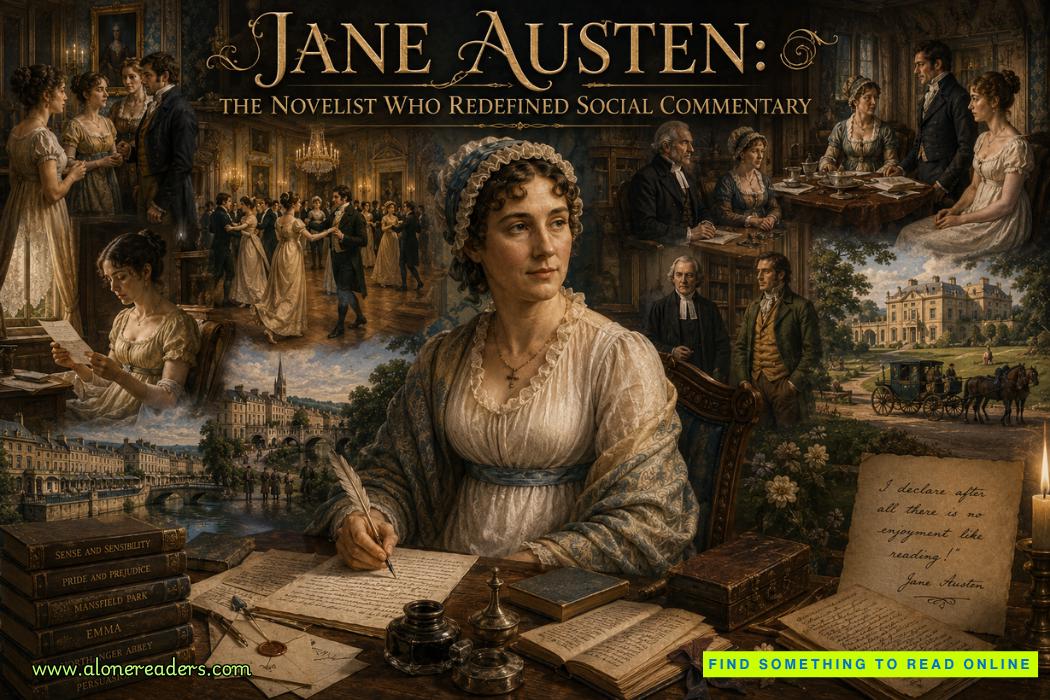
Jane Austen occupies an unusual position in literary and cultural history. Her novels are filled with country houses, dances, proposals, visits, letters, dinners, embarrassing relatives, inheritance disputes, and carefully controlled conversations. There are no great battles at the center of her stories, no revolutionary manifestos, and few dramatic encounters with the political events transforming Europe during her lifetime. Yet beneath this apparently restrained world lies one of the most precise examinations of class, gender, money, marriage, reputation, and personal freedom ever produced by an English novelist. Austen transformed the everyday social environment of the landed and professional classes into a laboratory for studying power.
Born on December 16, 1775, at Steventon in Hampshire, Jane Austen grew up within the social world that later became the foundation of her fiction. Her father, George Austen, was an Anglican clergyman, while her mother, Cassandra Leigh Austen, came from a family with connections to the landed gentry. Jane was one of eight children and grew especially close to her elder sister, Cassandra. The Austen household was intellectually active. Books were readily available, family members read aloud, amateur theatrical performances were organized, and writing was encouraged. This environment helped Austen develop an unusually sophisticated understanding of language, characterization, irony, and social performance.
Her position was particularly valuable for a future novelist because she stood close enough to the English gentry to understand its customs while remaining economically vulnerable enough to recognize its inequalities. Austen was neither an aristocratic heiress nor an impoverished outsider. She inhabited the uncertain territory occupied by respectable women whose social position depended heavily upon family connections, income, inheritance, and marriage. That perspective became fundamental to her fiction.
As a young woman, Austen began producing comic writings, parodies, stories, and sketches now collectively known as her Juvenilia. These early works already demonstrate characteristics that would define her mature writing: skepticism toward sentimental conventions, delight in exposing hypocrisy, sharp dialogue, and an ability to reveal absurdity without abandoning sympathy for human weakness. During the 1790s she drafted early versions of works that eventually became Sense and Sensibility, Pride and Prejudice, and Northanger Abbey.
Austen's development occurred during an extraordinary historical period. Britain experienced the French Revolutionary and Napoleonic Wars, expanding imperial commerce, rapid economic change, political anxiety, and the early stages of industrial transformation. Her brothers connected her directly with some of this wider world. Francis and Charles Austen became naval officers, while other family relationships exposed her to questions of wealth, colonial connections, professional advancement, and social mobility. Although Austen rarely turned these developments into conventional historical plots, the pressures of her age continually appear at the edges and within the economic structures of her novels.
One of Austen's greatest achievements was recognizing that marriage could be simultaneously emotional, social, and economic. For women of her class, marriage was not merely a romantic conclusion. Married women possessed limited independent legal and financial power, respectable employment opportunities for genteel women were restricted, and inheritance systems frequently favored men. A woman's future could therefore depend upon whom she married—or whether she married at all.
This reality gives Sense and Sensibility, published anonymously in 1811 with the attribution “By a Lady,” much of its underlying force. The Dashwood women suffer economically after the death of Mr. Dashwood because inheritance arrangements leave them dependent upon the goodwill of male relatives. Austen then contrasts Elinor Dashwood's disciplined judgment with Marianne's emotional intensity. The novel is not simply a debate between reason and feeling. It explores what happens when women must navigate powerful emotions while living within institutions that offer them limited economic security.
Pride and Prejudice, published in 1813, developed Austen's social criticism with extraordinary precision. Elizabeth Bennet has become one of literature's most recognizable heroines because she combines intelligence, independence, humor, and fallibility. Her relationship with Fitzwilliam Darcy is romantic, but the novel surrounding them is deeply concerned with property, inheritance, status, family reputation, and unequal opportunity.
The Bennet estate of Longbourn is entailed away from the five Bennet daughters, making their future economically precarious. Mrs. Bennet's obsession with marriage is comic, but the economic danger beneath her behavior is entirely real. Charlotte Lucas's decision to marry the absurd Mr. Collins provides an even more revealing example. Charlotte does not possess Elizabeth's romantic expectations. She chooses security because the alternatives available to an unmarried woman with limited wealth are uncertain. Austen neither simply condemns nor celebrates that choice; instead, she forces readers to understand the system that makes it rational.
This ability to expose institutions through ordinary decisions is central to Austen's method. She rarely interrupts her narratives to deliver political lectures. Instead, she allows conversations, invitations, inheritances, proposals, introductions, and breaches of etiquette to reveal the hierarchy underneath polite society. A drawing room in an Austen novel can function almost like a political arena. Who may speak, who is ignored, who possesses money, who controls property, and whose reputation is vulnerable all determine the balance of power.
Mansfield Park, published in 1814, presents an even more complicated social environment. Fanny Price enters the wealthy Bertram household as a poor relation and remains acutely conscious of her dependent position. Her vulnerability allows Austen to explore hierarchy from within the family itself. The novel also contains the famous reference to Sir Thomas Bertram's Antigua estate, connecting the comfort of the English country house, however indirectly and controversially, with Britain's imperial and slave-based Atlantic economy. Modern scholarship has consequently examined Mansfield Park as part of wider discussions about empire, wealth, morality, and silence.
With Emma, published in 1815, Austen reversed the economic situation of many earlier heroines. Emma Woodhouse is wealthy and declares that she has little reason to marry. Her privilege gives her unusual independence, but Austen uses that privilege to investigate another question: what happens when someone with social power misunderstands those around her?
Emma's matchmaking becomes dangerous because she treats other people's lives as puzzles she can arrange. Her relationship with Harriet Smith demonstrates the consequences of class assumptions, while her cruel remark to Miss Bates at Box Hill exposes the ethical responsibilities accompanying privilege. Miss Bates is socially respectable but financially insecure, making Emma's public mockery particularly painful. Austen's social criticism therefore concerns not only institutions but also the moral obligations created by inequality.
Persuasion, completed near the end of Austen's life and published posthumously in 1817, offers a more mature and melancholic perspective. Anne Elliot once rejected Captain Frederick Wentworth partly because he lacked fortune and established social standing. Years later, Wentworth returns successful after a naval career, while Anne's aristocratic father, Sir Walter Elliot, remains obsessed with rank despite financial irresponsibility.
The reversal is significant. The traditional landed elite appears vain and economically incompetent, while naval officers represent achievement, professionalism, and mobility. Austen was observing a society in which inherited status increasingly existed alongside wealth and distinction acquired through professional service. Persuasion therefore quietly captures a changing Britain in which merit and inherited rank no longer fit comfortably together.
Austen's technique made these observations especially powerful. She became a master of free indirect discourse, a narrative method that allows third-person narration to move closely into a character's perceptions without consistently announcing the transition. Readers can experience Elizabeth's judgments, Emma's assumptions, or Anne's reflections while simultaneously receiving subtle indications that those perceptions may be incomplete.
Irony was equally important. Austen's famous opening of Pride and Prejudice immediately establishes a world in which social assumptions are presented with such exaggerated confidence that their absurdity becomes visible. Throughout her fiction, characters often expose themselves through their own speech. Mr. Collins reveals servility while imagining himself dignified; Lady Catherine de Bourgh displays arrogance while believing herself authoritative; Sir Walter Elliot exposes vanity while considering himself a guardian of social distinction.
This is why describing Austen merely as a writer of romance seriously underestimates her achievement. Courtship provides the narrative framework through which she studies larger systems. Who can afford to marry? Who controls property? Whose judgment matters? What happens to women without money? How does class influence supposedly personal choices? These questions repeatedly transform private relationships into social commentary.
Austen understood these pressures personally. She never married. In 1802 she briefly accepted a proposal from Harris Bigg-Wither, a financially advantageous match, but withdrew her acceptance the following morning. The precise reasons remain unknowable, yet the episode demonstrates that Austen herself encountered the tension between marriage, economic security, and personal choice that appears throughout her fiction.
Her professional career was also shaped by the limitations facing female authors. Her books initially appeared anonymously. Publishing involved financial risk and negotiations conducted within a literary marketplace overwhelmingly dominated by men. Nevertheless, Austen gradually achieved commercial success. During her lifetime, readers knew her works, even though her public identity remained comparatively restrained. Her brother Henry later revealed her authorship more openly.
Austen's final years were marked by declining health. She continued writing despite worsening illness and began the unfinished novel later known as Sanditon. She died in Winchester on July 18, 1817, aged forty-one, and was buried in Winchester Cathedral. Northanger Abbey and Persuasion appeared together after her death, accompanied by a biographical notice written by Henry Austen.
Her reputation expanded dramatically over the following two centuries. Victorian readers admired her domestic realism, later critics increasingly recognized her technical sophistication, and modern scholars have examined her work through perspectives involving gender, economics, empire, property law, class, psychology, and narrative theory. Her novels have generated countless adaptations while phrases and characters from her fiction have entered popular culture.
Yet Austen's enduring importance cannot be explained simply by memorable romances or elegant Regency settings. Her deeper accomplishment was demonstrating that ordinary social behavior could reveal the architecture of an entire society. A conversation at dinner might expose class prejudice. A marriage proposal could reveal economic dependence. An inheritance could determine a woman's future. A ballroom could become a stage upon which wealth, attraction, reputation, and hierarchy interacted.
That insight helped redefine what the novel could accomplish. Austen did not require kings, wars, or revolutions to write about power. She found power operating inside families, estates, drawing rooms, marriages, friendships, and conversations. Her characters inhabit a world where manners appear delicate but consequences can be severe, particularly for people without wealth or social protection.
More than two centuries after her death, Jane Austen remains influential because the mechanisms she observed have not entirely disappeared. People still negotiate status, money, reputation, attraction, social expectations, and the difference between appearance and character. Her historical world was specifically Regency England, but her psychological observations transcend it. Through precision, irony, realism, and extraordinary control of perspective, Jane Austen turned the intimate world of everyday life into one of literature's most enduring forms of social criticism.





 The Hundred Days Offensive: How the Allies Defeated Germany in World War I
 The Second Battle of the Marne: The Turning Point of World War I in 1918
 The Spring Offensive of 1918: Germany's Final Gamble to Win World War I
 The Treaty of Brest-Litovsk: How Russia Left World War I
 The Russian Revolution and World War I: How War Brought Down the Tsar
 The Zimmermann Telegram Explained: Germany's Secret Offer to Mexico in World War I