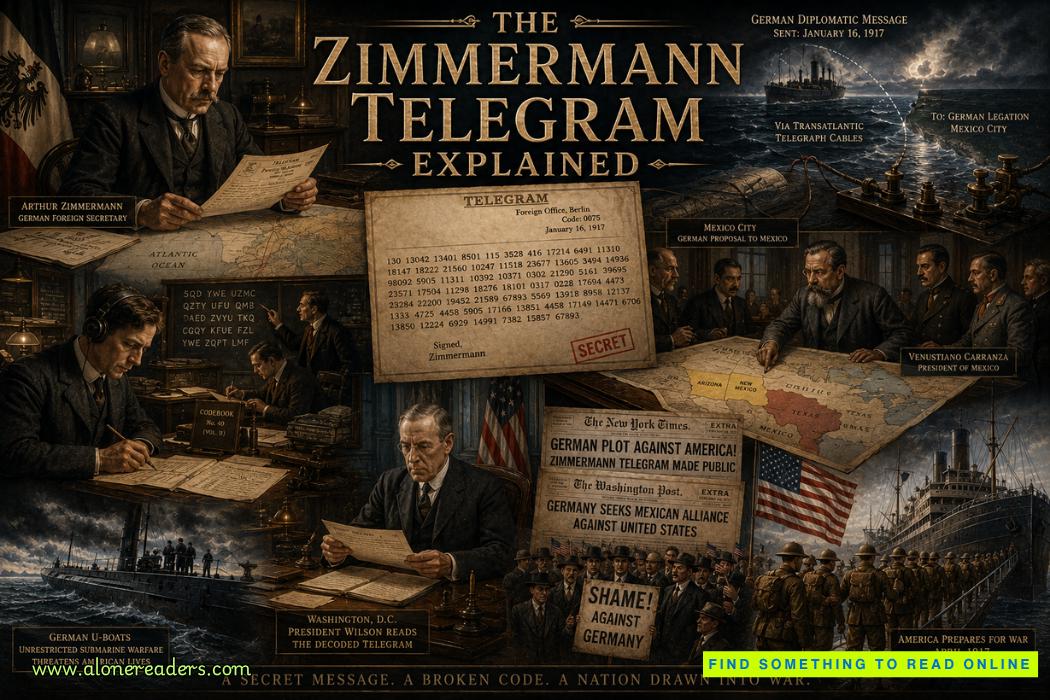
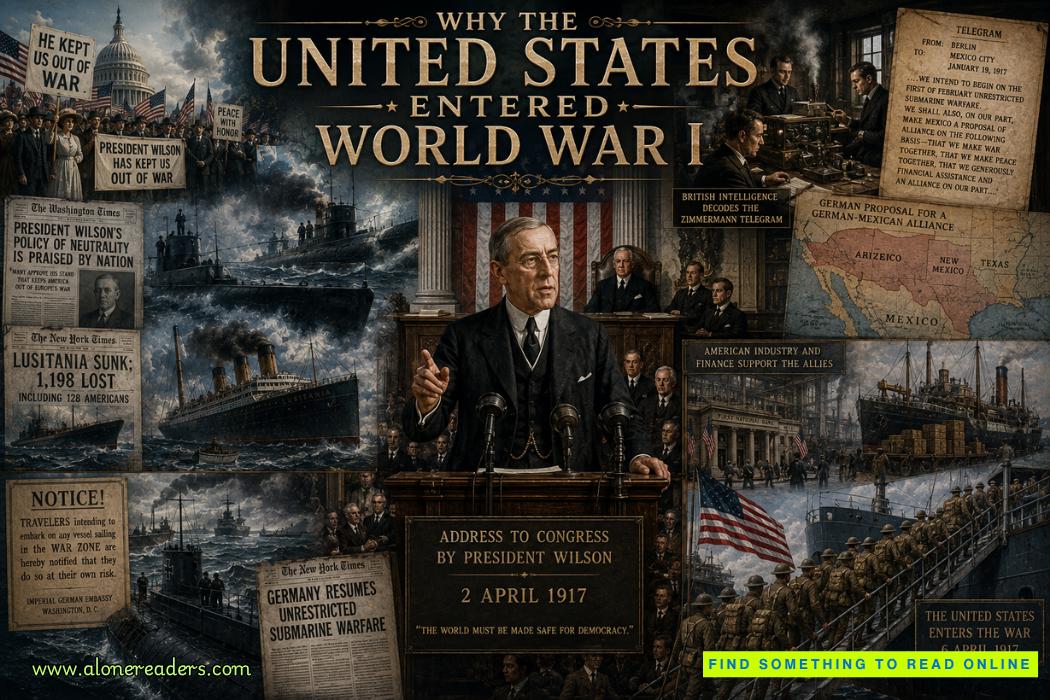
The Zimmermann Telegram was one of the most extraordinary diplomatic intelligence episodes of World War I. Sent secretly by Germany in January 1917, the coded message proposed a military alliance between Germany and Mexico if the United States entered the war against Germany. In exchange for Mexican participation, Berlin promised financial assistance and suggested that Mexico could recover territories it had lost to the United States during the nineteenth century—specifically Texas, New Mexico, and Arizona. British intelligence intercepted and decoded the message before secretly passing it to the American government. When its contents became public on 1 March 1917, many Americans were outraged. Combined with Germany's resumption of unrestricted submarine warfare, the Zimmermann Telegram helped transform American opinion and contributed significantly to the United States declaring war on Germany in April 1917.
To understand why Germany made such an apparently extraordinary proposal, it is necessary to examine the military situation at the beginning of 1917. World War I had already lasted for more than two years, and Germany faced increasingly serious strategic problems. The Western Front remained deadlocked after the enormous battles of Verdun and the Somme, while the British naval blockade restricted German access to food, fertilizer, metals, and other essential imports.
German leaders believed that unrestricted submarine warfare offered their best opportunity to break the stalemate. U-boats could attack merchant shipping supplying Britain and potentially reduce imports so severely that the country might be forced to negotiate peace.
The danger was obvious. Unrestricted submarine warfare would inevitably threaten neutral vessels, including American ships. Germany had already experienced serious diplomatic confrontations with Washington after the sinking of RMS Lusitania in 1915 and other submarine attacks.
President Woodrow Wilson had repeatedly warned Germany that the United States would defend its maritime rights. German leaders therefore understood that resuming unrestricted submarine warfare might eventually cause America to enter the conflict.
Nevertheless, German military planners made a calculated gamble. They estimated that their submarines could destroy enough shipping to force Britain from the war within approximately six months. Even if the United States declared war, they believed America would require far longer to mobilize a large army and transport it across the Atlantic.
Germany therefore announced that unrestricted submarine warfare would resume on 1 February 1917.
The Zimmermann Telegram was designed partly as insurance against the expected American reaction. If the United States entered the war, Germany hoped that a conflict with Mexico might divert American soldiers and resources away from Europe.
The message originated with Arthur Zimmermann, Germany's Secretary of State for Foreign Affairs. On 16 January 1917, Zimmermann sent a coded diplomatic telegram to Heinrich von Eckardt, the German minister in Mexico. The message was transmitted through diplomatic channels to the German ambassador in Washington, Count Johann von Bernstorff, who would forward it to Mexico.
The telegram informed German diplomats that unrestricted submarine warfare would begin on 1 February. Germany hoped the United States would nevertheless remain neutral. However, if American neutrality could not be preserved, Germany proposed that Mexico should enter the war as Germany's ally.
The proposed arrangement was remarkable. Germany would provide financial assistance, while Mexico would attack the United States. After victory, Germany suggested that Mexico should recover its former territories of Texas, New Mexico, and Arizona.
These regions had been part of Mexico before the Mexican-American War of 1846–1848 and the subsequent Treaty of Guadalupe Hidalgo. Their loss remained historically significant in Mexican-American relations, making the territorial proposal potentially attractive from a German perspective.
Zimmermann also suggested that Mexico might attempt to persuade Japan to join the proposed arrangement. This part of the plan was particularly unrealistic because Japan was already formally allied with Britain and had entered World War I against Germany in 1914. Japanese forces had captured German possessions in China and the Pacific.
Germany's proposal to Mexico was therefore ambitious but strategically desperate. Berlin was attempting to create a military distraction in North America that might prevent the United States from sending substantial forces to Europe.
The telegram might have remained secret if not for one of Britain's most important intelligence operations of the war.
Britain possessed significant access to international telegraph communications. Early in the conflict, British forces had cut Germany's direct undersea telegraph cables, forcing Berlin to rely upon alternative communications networks. British intelligence exploited this vulnerability.
The Royal Navy's cryptographic organization, commonly known as Room 40, specialized in intercepting and decoding German communications. Its analysts had already obtained German naval and diplomatic codebooks through captured materials and intelligence operations.
British intelligence intercepted the Zimmermann message and gradually decoded it. The result was extraordinary: Germany was secretly proposing a war against the United States while simultaneously attempting to avoid immediate American intervention.
Yet Britain faced a serious problem. Simply giving the decoded telegram to Washington could reveal how British intelligence had obtained it. Germany might then change its codes or communication procedures, destroying an extremely valuable source of intelligence.
There was another diplomatic complication. Part of the message had traveled using communications facilities made available for German diplomatic messages under circumstances connected with American efforts to facilitate peace negotiations. Revealing British interception could therefore expose politically sensitive intelligence capabilities.
British intelligence needed to find a way to reveal the telegram without revealing exactly how it had been intercepted.
The solution was an ingenious intelligence operation. British agents obtained another version of the message from telegraph communications in Mexico. Because this version could plausibly have been intercepted locally, Britain could present it to the Americans while protecting the most sensitive details of its intelligence network.
The decoded telegram was eventually provided to the American ambassador in London, Walter Hines Page, who transmitted the information to President Wilson's administration.
Wilson received confirmation of the message in late February 1917. Its contents immediately appeared explosive. The president authorized publication, understanding that the telegram could demonstrate the potential threat posed by German policy.
On 1 March 1917, American newspapers published the story.
The reaction was immediate. Headlines announced that Germany had attempted to encourage Mexico to wage war against the United States. For Americans who had regarded World War I as a distant European conflict, the telegram suddenly suggested that German strategy could involve American territory itself.
Some Americans initially doubted the telegram's authenticity. German-American organizations and anti-war voices suggested it might be fabricated British propaganda designed to drag the United States into the conflict.
Such suspicions were understandable. Britain had powerful reasons to encourage American intervention, and wartime propaganda regularly contained exaggerated or misleading claims.
Then Arthur Zimmermann did something remarkable: he publicly admitted that the telegram was genuine.
On 3 March, Zimmermann acknowledged the message, and he later defended it publicly. His argument was essentially that Germany had proposed the Mexican alliance only in the event that the United States entered the war against Germany. From Berlin's perspective, it was a contingency plan rather than an unprovoked declaration of aggression.
Politically, however, the admission was disastrous. It eliminated the strongest argument available to opponents of intervention—that the document had been invented by British intelligence.
The Mexican government also considered the German proposal, although there was little realistic possibility that it would accept. President Venustiano Carranza ordered military advisers to evaluate the plan.
Their conclusions were unfavorable.
Mexico was emerging from years of revolution and internal conflict. Its military and economy were in no condition to conduct a major war against the United States. The disparity in industrial capacity, population, transportation, and military resources was enormous.
Recovering Texas was especially unrealistic. By 1917, Texas had been part of the United States for more than seventy years and contained a large American population. Even if Mexican troops somehow captured territory, occupying and administering it would have been extraordinarily difficult.
Germany also faced a basic logistical problem: how could it provide substantial military assistance to Mexico while the British Royal Navy controlled the Atlantic? Supplying weapons, ammunition, troops, or heavy equipment across the ocean would have been extremely difficult.
Mexico therefore rejected the proposal.
Relations between Mexico and the United States were nevertheless genuinely tense at the time. The Mexican Revolution had created instability along the border. In 1916, revolutionary leader Pancho Villa attacked Columbus, New Mexico, killing Americans and prompting a U.S. military response.
General John J. Pershing led the Punitive Expedition into Mexico in an unsuccessful attempt to capture Villa. American and Mexican troops even clashed during the operation. Germany therefore had some reason to believe existing tensions could potentially be exploited.
But Germany greatly overestimated the likelihood that Mexico would accept the risks of a full-scale war against its far more powerful northern neighbor.
The Zimmermann Telegram was not, by itself, the reason the United States entered World War I. Germany's unrestricted submarine campaign remained the more immediate strategic cause.
On 3 February 1917, before the telegram became public, Wilson had already broken diplomatic relations with Germany over unrestricted submarine warfare. During the following weeks, German U-boats attacked shipping in the Atlantic, including vessels connected with the United States.
By March, several American merchant ships had been sunk. The combination of submarine attacks and the Zimmermann revelation created a powerful political effect. One demonstrated Germany's willingness to endanger American lives and commerce at sea; the other revealed a contingency plan involving an enemy alliance on American soil.
The international situation also changed dramatically because of events in Russia. In March 1917, the Russian Revolution overthrew Tsar Nicholas II and created a provisional government. This made it easier for Wilson to describe the Allied cause as a struggle involving democratic governments against authoritarian militarism.
On 2 April 1917, Wilson appeared before Congress and requested a declaration of war against Germany. He argued that German submarine warfare represented a war against humanity and international rights, while presenting American intervention as part of a broader effort to establish a safer international system.
Four days later, on 6 April 1917, the United States formally declared war on Germany.
The importance of the Zimmermann Telegram therefore lies primarily in its effect upon public opinion and political perception. Americans had spent nearly three years debating whether events in Europe represented a direct threat to the United States. Germany's secret proposal appeared to provide dramatic evidence that geographical distance did not guarantee security.
The incident was also a remarkable triumph for signals intelligence and cryptanalysis. Room 40 did more than read an enemy diplomatic message. British intelligence carefully managed how the information was revealed, protected valuable intelligence sources, and ensured that the telegram reached American leaders at a politically decisive moment.
It demonstrated that information itself could become a strategic weapon. A message consisting only of coded words helped influence the diplomatic direction of one of the world's most powerful nations.
The affair also illustrates the dangers of contingency diplomacy. From Germany's perspective, Zimmermann's proposal was conditional: Mexico would be approached as a military ally only if the United States entered the war against Germany. Yet once exposed publicly, those qualifications mattered far less than the headline that Germany had proposed helping Mexico recover American territory.
Germany's strategy ultimately produced the opposite of what it intended. The telegram was supposed to create a distraction if America entered the war. Instead, its discovery helped strengthen support for American intervention.
The broader German gamble failed as well. Unrestricted submarine warfare did not force Britain to surrender before American power became effective. The Allied convoy system reduced shipping losses, while American industry, finance, naval assistance, and eventually millions of soldiers strengthened the Allied coalition.
By 1918, American troops were arriving in Europe in rapidly increasing numbers. Germany's attempt to prevent effective American intervention had therefore contributed indirectly to precisely the outcome its leaders feared.
Ultimately, the Zimmermann Telegram became one of the most consequential intercepted communications in modern history. Germany's secret proposal to Mexico was militarily unrealistic, but its political consequences were profound. British codebreakers exposed the plan, Zimmermann himself confirmed its authenticity, and Americans were confronted with evidence that the European war could potentially threaten their own national security. Combined with unrestricted submarine warfare, the telegram helped destroy the remaining political foundations of American neutrality. It did not single-handedly bring the United States into World War I, but it helped turn Germany from a distant belligerent into an enemy that many Americans increasingly believed had to be confronted.


 The Hundred Days Offensive: How the Allies Defeated Germany in World War I
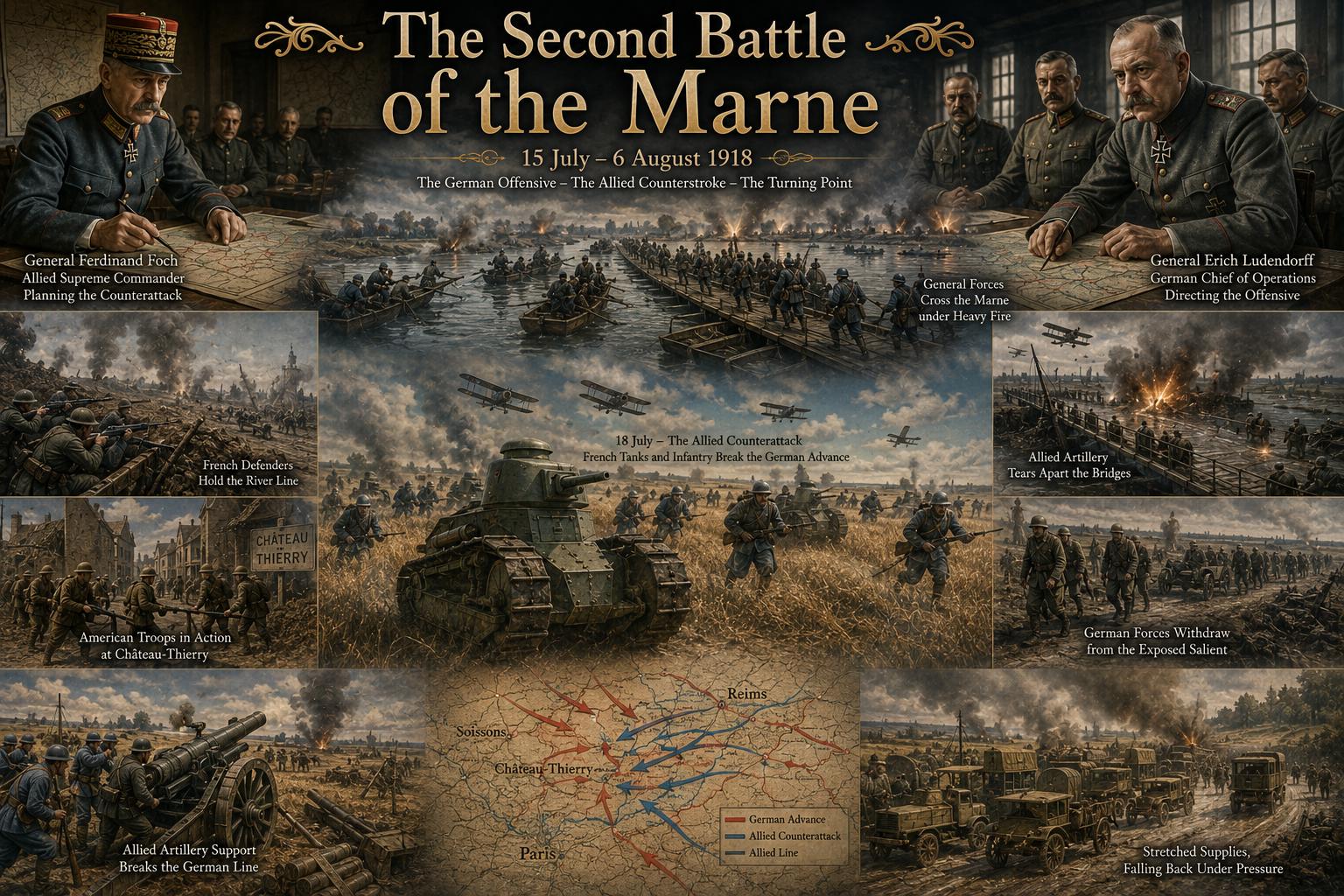 The Second Battle of the Marne: The Turning Point of World War I in 1918
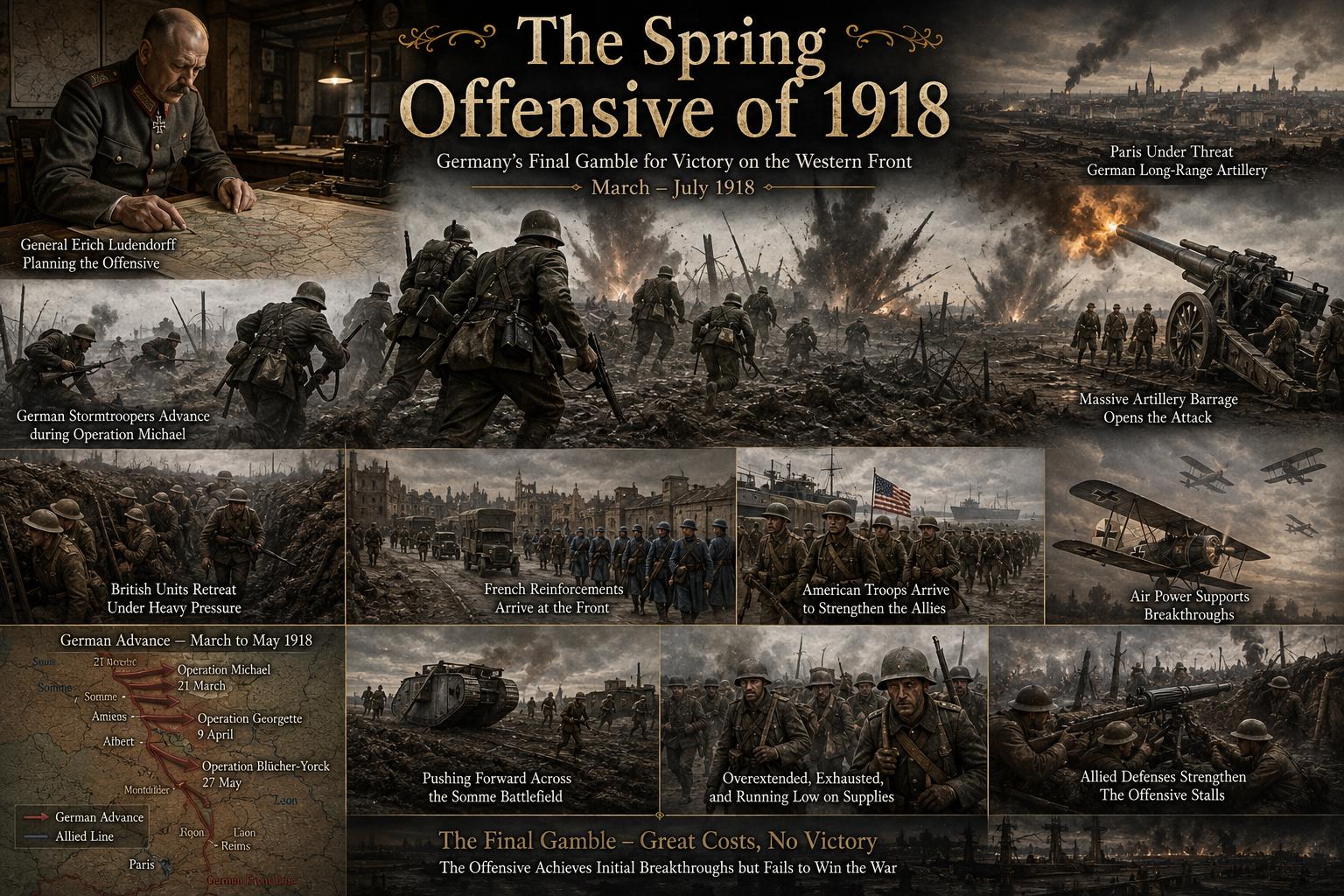 The Spring Offensive of 1918: Germany's Final Gamble to Win World War I
 The Treaty of Brest-Litovsk: How Russia Left World War I