Across the Iranian plateau, human settlement has always faced a fundamental problem: water often exists where people cannot easily reach it. Large areas receive little rainfall, summers can be intensely hot, rivers may be seasonal, and surface water evaporates rapidly. Yet beneath mountain foothills and alluvial plains, groundwater accumulated in geological formations that could support agriculture and permanent communities—if engineers could find a reliable way to bring it to the surface.
Ancient Persian societies developed an extraordinarily elegant answer. Instead of repeatedly lifting groundwater from deep wells, they constructed gently sloping underground tunnels known as qanats, designed to intercept groundwater at higher elevations and carry it toward lower land entirely through gravity. Once completed, a qanat could deliver water continuously without pumps, fuel, animal power, or a constantly operating mechanical system.
The concept appears simple. Its execution was anything but.
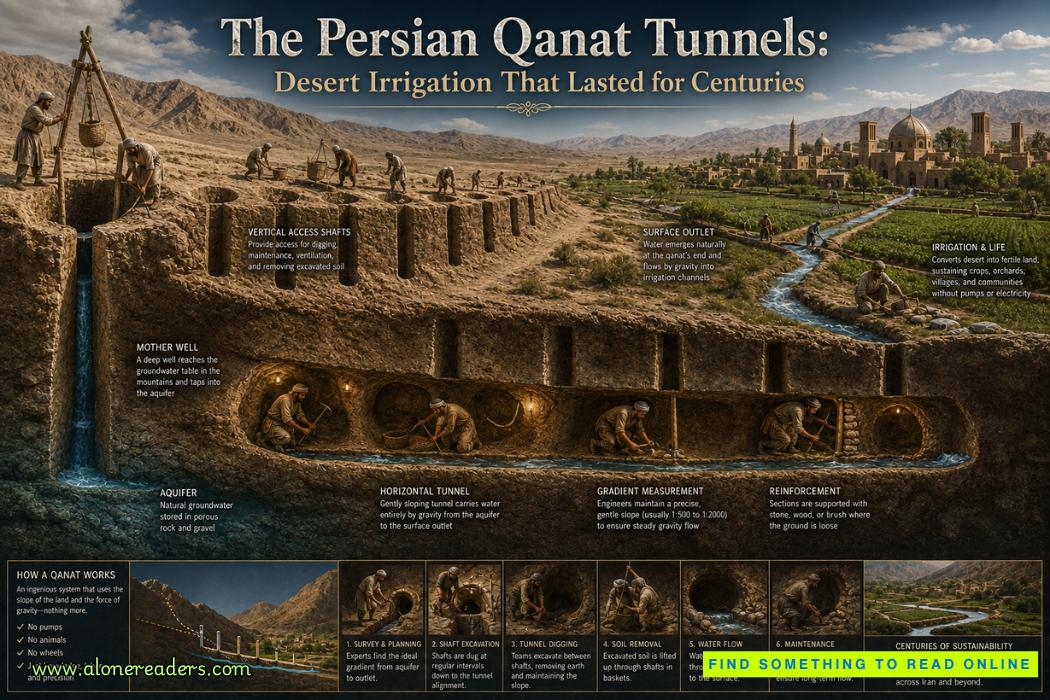
A typical qanat consisted of several interconnected elements: a deep mother well, a gently inclined underground gallery, numerous vertical shafts, and a surface outlet where water emerged and entered canals or distribution systems. The mother well was excavated into a water-bearing geological layer, usually near the foothills of mountains. From this high point, workers constructed a tunnel toward lower ground, maintaining a carefully controlled downward gradient.
Gravity did the rest.
Because the outlet was lower than the groundwater source, water entering the tunnel naturally flowed toward the settlement or agricultural land. The system converted differences in elevation into a permanent source of hydraulic energy. No wheel needed to turn and no pump needed to operate.
This was particularly well suited to the Iranian environment. Mountain precipitation and snowmelt could infiltrate porous soils and fractured rock, replenishing underground aquifers. Surface streams might disappear or fluctuate dramatically, but groundwater could remain comparatively protected from the intense heat above.
By intercepting this water underground, qanats also minimized one of the greatest enemies of irrigation in dry climates: evaporation. An open canal running across kilometers of hot desert could lose significant quantities of water before reaching crops. A qanat transported much of its supply beneath the ground, protected from direct sunlight and hot, dry winds.
The origins of qanat technology are difficult to establish with absolute precision, but it was firmly associated with the Iranian world by the first millennium BC and was likely developed there before spreading widely. Under successive Persian states, including the Achaemenid Empire, qanat technology became part of a broader tradition of hydraulic engineering that helped sustain agriculture and settlements in arid regions.
The most technically demanding stage of qanat construction was identifying a suitable source. Experienced specialists needed to understand the landscape well enough to determine where groundwater was likely to exist. Vegetation, geological formations, seasonal water behavior, existing springs, soil conditions, and mountain drainage patterns could all provide clues.
Once a promising location had been selected, workers excavated a vertical shaft downward toward the aquifer. This mother well could reach considerable depth, depending upon the terrain and groundwater table. Some qanat systems required shafts extending tens of meters underground, while exceptional examples descended much farther.
Finding water was only the beginning. The engineers then had to connect that elevated underground source with a distant outlet at lower elevation.
This required extraordinary control of gradient. If the tunnel descended too steeply, fast-flowing water could erode its floor and walls, damaging the system. If the slope was too shallow or accidentally reversed, water could stagnate or fail to reach the destination. A successful qanat therefore depended upon maintaining a subtle downward inclination over distances that could extend for many kilometers.
The builders accomplished this without laser levels, satellite surveying, or modern precision instruments. Instead, generations of specialist qanat builders developed practical surveying techniques using simple leveling devices, cords, measuring rods, visual alignment, and accumulated knowledge of local terrain.
The underground gallery was usually narrow because there was no reason to excavate a large passage. It needed enough space for workers to dig, remove debris, inspect the tunnel, and conduct repairs. Keeping the gallery relatively small also reduced excavation labor and helped maintain structural stability.
Perhaps the most recognizable features of qanat landscapes are the rows of vertical shafts visible across otherwise barren ground. From above, they can appear as long chains of circular openings or spoil mounds stretching toward the horizon.
These shafts performed several essential functions. During construction, they provided access to the underground gallery. Excavated material could be hauled vertically to the surface rather than carried through kilometers of narrow tunnel. They also provided ventilation and created multiple working points, allowing crews to excavate sections of the gallery simultaneously.
After completion, the shafts remained crucial for maintenance. Workers could descend at different locations to remove sediment, clear collapses, repair damaged sections, and inspect water flow. The vertical shafts transformed an inaccessible underground tunnel into infrastructure that could be maintained generation after generation.
Excavation was dangerous work. Qanat builders operated in confined spaces where collapse, poor ventilation, falling material, and groundwater posed serious hazards. The deeper shafts presented particular risks. Skilled specialists therefore required intimate knowledge of soils and geological stability.
In competent ground, tunnel walls might remain largely unsupported. Where unstable sediment threatened collapse, builders could reinforce vulnerable sections using stone, fired brick, ceramic rings, or other locally available materials. The exact construction method varied according to geology, region, period, and resources.
The excavated soil itself created a characteristic surface signature. Material hauled from shafts accumulated around their openings, often producing circular mounds. These could also help prevent surface runoff and loose debris from falling directly into the shafts.
Once water reached the qanat's outlet, known in some contexts as the mazhar, it entered a completely different hydraulic environment. Underground water transport became surface water distribution. Channels directed the flow toward fields, orchards, gardens, reservoirs, public facilities, and domestic users.
This made qanats far more than isolated tunnels. They formed the upstream component of complex water-management systems.
In many Persian communities, water allocation became highly organized. Because a qanat produced a limited flow, access had to be divided among users. Shares might be allocated according to specific periods of time, agricultural holdings, inherited rights, or community agreements. Individuals responsible for supervising distribution could ensure that farmers received water according to established schedules.
Water therefore influenced not only engineering but also property, law, social organization, and local economics.
Qanats enabled cultivation in locations where dependable agriculture would otherwise have been extremely difficult. Wheat and other crops could be irrigated, while orchards produced fruits such as pomegranates, grapes, apricots, and pistachios depending on local conditions. Gardens and tree cover transformed selected areas of dry landscape into productive agricultural zones.
The technology also influenced where settlements developed. A dependable qanat could provide the water necessary for a village or town to grow, meaning that the underground route of water could help determine the geography of human habitation.
Persian hydraulic ingenuity did not stop when water emerged from the qanat. In some urban environments, qanat water interacted with reservoirs, distribution channels, gardens, baths, and traditional cooling systems. The famous Persian garden tradition depended heavily upon controlled water, using channels and carefully organized flows to combine irrigation with architectural and aesthetic design.
One reason qanats could remain operational for centuries was their remarkably low energy requirement. Once constructed, gravity supplied the force necessary to move water. There were no engines to fuel, mechanical pumps to replace, or complex moving components to maintain.
That did not mean qanats required no maintenance. Sediment accumulated. Shafts deteriorated. Earthquakes could damage galleries. Roots could interfere with channels, while tunnel sections could collapse. Groundwater conditions could also change.
Their longevity depended upon regular human intervention. Specialized workers periodically entered the systems to clean and repair them. In this sense, a qanat was sustainable because communities maintained it continuously, not because it was maintenance-free.
The method also possessed an important hydrological characteristic. A traditional gravity-fed qanat generally could not draw groundwater in the same aggressive manner as a powerful deep-well pump. Its output depended upon the groundwater level intersecting the tunnel. When the water table fell, flow often declined.
This did not automatically guarantee sustainability, especially when many qanats exploited the same aquifer or climatic conditions changed, but it created a natural limitation absent from modern high-capacity pumping.
The technology eventually spread far beyond Persia. Related underground water systems appeared across parts of the Middle East, Central Asia, North Africa, the Arabian Peninsula, and Mediterranean regions. Different cultures used different names—including falaj, karez, kariz, and foggara—and adapted the principle to local geography.
This diffusion demonstrates how successful the fundamental concept was. Wherever dry climates coincided with suitable topography and accessible groundwater at higher elevation, underground gravity channels could transform the possibilities for settlement and agriculture.
Some Persian qanats reached extraordinary dimensions. Individual systems could extend many kilometers, contain hundreds or even thousands of vertical shafts, and serve communities for generations. Constructing them represented an enormous initial investment of skilled labor, but the long operational lifespan could justify that effort.
Their scale also reveals something important about ancient engineering. Monumental achievement is often associated with structures visible above ground—pyramids, temples, aqueducts, bridges, and defensive walls. Qanats were different. Much of their engineering brilliance was deliberately invisible.
A traveler might see a green settlement surrounded by desert without realizing that its water had traveled kilometers through a hand-excavated tunnel beneath the landscape.
This hidden character makes qanats one of history's most sophisticated examples of environmental adaptation. Their builders did not attempt to force large rivers across impossible distances or lift enormous quantities of groundwater using continuous mechanical energy. They studied geology, elevation, groundwater, and gravity, then designed infrastructure around the natural behavior of those systems.
The result was not merely a tunnel but an integrated technology involving hydrology, surveying, excavation, ventilation, structural stabilization, water allocation, maintenance, and agricultural planning.
Modern groundwater pumping has reduced dependence on qanats in many regions. Electric and diesel pumps can extract large quantities of water rapidly and from considerable depths. Yet this capability can also produce severe aquifer depletion when extraction exceeds natural recharge. Falling groundwater tables have caused numerous traditional qanats to lose flow or dry completely.
For this reason, qanats have acquired renewed relevance in discussions about sustainable water management. They cannot simply replace modern water infrastructure, nor were historical systems environmentally perfect. Nevertheless, they demonstrate a fundamentally different relationship between engineering and scarce natural resources.
Persian qanat builders created infrastructure that worked with gravity, topography, and groundwater rather than depending upon continuous external energy. Their tunnels made deserts cultivable, sustained settlements, supported sophisticated systems of water rights, and transmitted an engineering tradition across continents.
For centuries, much of this infrastructure operated quietly beneath the feet of the people who depended upon it. That may be the most impressive aspect of the Persian qanat. Unlike monuments designed primarily to proclaim the power of rulers, its success was measured every day in something far more practical: water continuing to emerge from dry ground, year after year, generation after generation.



 The Second Battle of the Marne: The Turning Point of World War I in 1918
 The Spring Offensive of 1918: Germany's Final Gamble to Win World War I
 The Treaty of Brest-Litovsk: How Russia Left World War I
 The Russian Revolution and World War I: How War Brought Down the Tsar
 The Zimmermann Telegram Explained: Germany's Secret Offer to Mexico in World War I
 Why the United States Entered World War I: From Neutrality to War in 1917