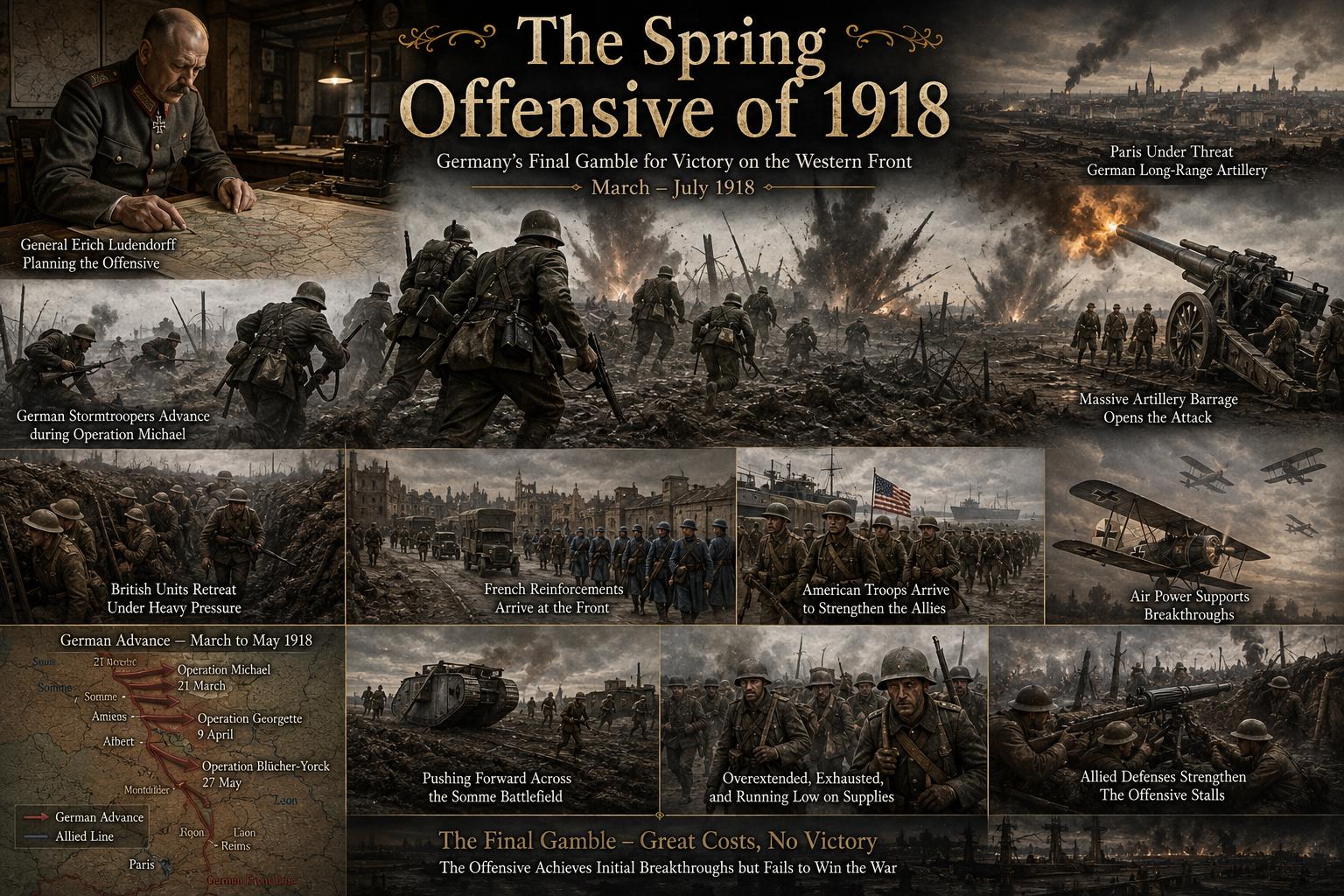
The Spring Offensive of 1918 was Imperial Germany's last great attempt to win World War I before the rapidly expanding military power of the United States made an Allied victory increasingly inevitable. Beginning on 21 March 1918, German armies launched a sequence of massive attacks across the Western Front using concentrated artillery, specialized stormtroopers, infiltration tactics, and divisions transferred from the former Eastern Front after Russia's withdrawal from the war. The attacks achieved spectacular territorial gains. Allied defenses collapsed across several sectors, tens of thousands of prisoners were captured, and German troops advanced farther in weeks than armies had moved during years of trench warfare. Paris once again appeared threatened. Yet Germany never converted these tactical victories into a decisive strategic breakthrough. By exhausting Germany's best soldiers without destroying the Allied armies, the Spring Offensive ultimately accelerated the military collapse it had been designed to prevent.
Germany entered 1918 facing a narrow window of opportunity. Russia had effectively withdrawn from the war following the Bolshevik Revolution, and the Treaty of Brest-Litovsk, signed on 3 March 1918, formally ended fighting on the Eastern Front. Germany could now transfer dozens of divisions westward.
For the first time in years, the Germans possessed a temporary numerical advantage on the Western Front.
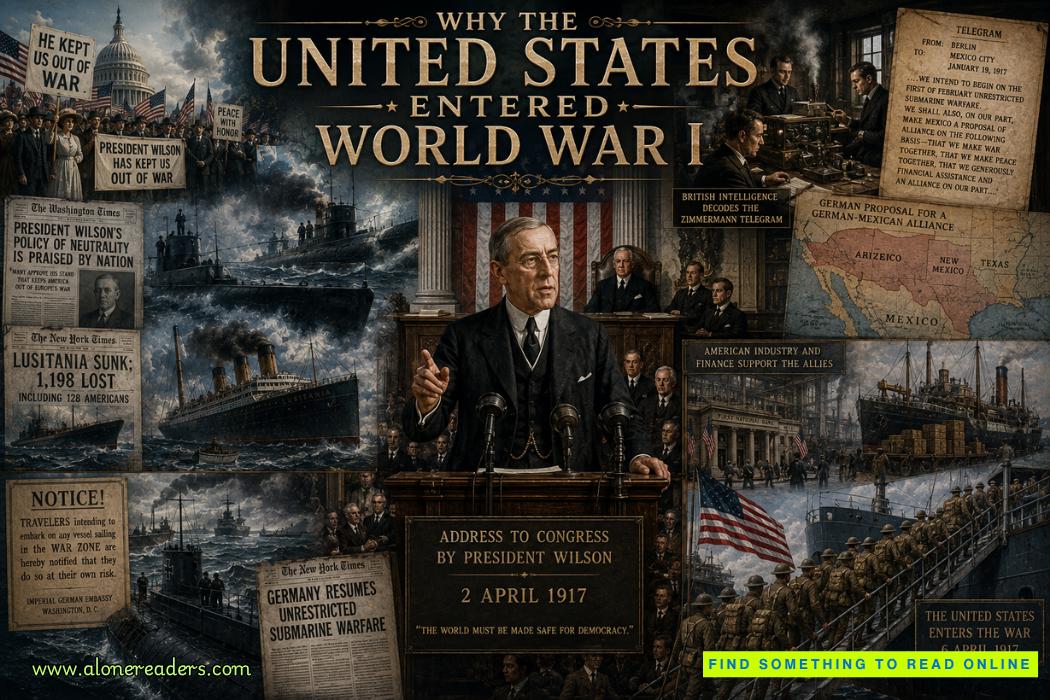
Yet this advantage would not last. The United States had entered the war in April 1917, and American soldiers were arriving in Europe in rapidly increasing numbers. Germany's military leadership understood that once millions of American troops became available, the Central Powers could not realistically match the Allies in manpower, industrial production, financial resources, and access to global supplies.
Germany also suffered internally. The British naval blockade had created severe shortages of food and raw materials. Civilians endured declining nutrition, while industrial production struggled under wartime pressure. The German Army remained formidable, but years of fighting at Verdun, the Somme, Passchendaele, and elsewhere had consumed enormous numbers of experienced soldiers.
General Erich Ludendorff, effectively directing German military operations alongside Field Marshal Paul von Hindenburg, concluded that Germany had to win quickly.
The Spring Offensive was therefore not simply another attack—it was a calculated gamble based on the belief that Germany's strategic position would become worse with every passing month.
The Germans had learned important tactical lessons from earlier battles. Traditional attacks often began with prolonged artillery bombardments lasting days. These bombardments warned defenders where an offensive was coming, destroyed roads needed by attackers, and gave enemy reserves time to move into position.
German planners developed a different approach.
Artillery specialist Colonel Georg Bruchmüller helped organize short, extraordinarily intense bombardments designed to achieve surprise. Instead of attempting to destroy every enemy trench, artillery targeted headquarters, communications, artillery batteries, transportation routes, and command centers.
High explosive shells were combined with smoke and chemical weapons. The goal was neutralization rather than complete destruction—temporarily preventing Allied units from responding effectively while German infantry broke through.
German infantry tactics had also evolved. Specialized Sturmtruppen, or stormtroopers, were trained to infiltrate enemy positions rather than attack every defensive strongpoint directly.
Small assault groups moved rapidly through weak points, bypassing heavily defended bunkers and machine-gun nests. Follow-up troops could eliminate isolated positions while stormtroopers penetrated deeper into the enemy rear.
These units carried portable weapons suited to mobile warfare, including grenades, light machine guns, mortars, flamethrowers, and rifles. Junior officers and noncommissioned officers received greater freedom to make tactical decisions without waiting for detailed instructions from higher headquarters.
The first and largest attack was Operation Michael, launched on 21 March 1918.
Its primary target was the British Fifth Army along the Somme sector, near the junction between British and French forces. Ludendorff hoped to break through British defenses, separate the British Army from the French, and drive British forces northwestward toward the Channel ports.
The offensive began with one of the most intense artillery bombardments of the entire war. Thousands of German guns and mortars opened fire before dawn. Fog covered parts of the battlefield, helping German infantry approach Allied positions unseen.
The results were devastating.
British forward positions were overwhelmed across numerous sectors. Communications broke down, headquarters lost contact with units, and German stormtroopers penetrated through gaps before defenders fully understood the scale of the attack.
On the first day alone, the British suffered enormous casualties, including tens of thousands of soldiers captured.
German forces advanced rapidly across territory devastated during the Battle of the Somme in 1916. Towns and villages that had taken months to capture in earlier campaigns changed hands within days.
The British Fifth Army, commanded by General Hubert Gough, conducted a difficult fighting retreat. Some units collapsed or became surrounded, while others organized determined rear-guard defenses that delayed the German advance.
The scale of the breakthrough created a serious Allied command crisis.
Britain and France had separate command structures, and disagreements emerged over the deployment of reserves. British commanders feared losing the Channel ports, while French leaders worried that German forces might turn south toward Paris.
The crisis produced one of the most important organizational changes of the war. At the Doullens Conference on 26 March 1918, French General Ferdinand Foch was given responsibility for coordinating Allied operations. His authority was subsequently expanded, creating a much more unified Allied command structure.
This decision would become crucial during the later Allied counteroffensives.
Despite German success, Operation Michael began encountering fundamental problems.
The breakthrough itself created logistical difficulties. German infantry advanced faster than artillery, ammunition, food, and heavy equipment could follow. The battlefield contained destroyed roads, shell craters, trenches, and ruined villages left from earlier fighting.
Horses and supply wagons struggled to cross the devastated landscape.
German soldiers also discovered enormous Allied supply depots containing food and goods unavailable in Germany after years of blockade. Accounts describe exhausted and hungry soldiers stopping to consume captured provisions. Although this was not the primary reason the offensive failed, it illustrated the growing disparity between German shortages and Allied material resources.
More importantly, Ludendorff lacked a clear strategic objective once the initial breakthrough expanded.
He repeatedly redirected attacks toward areas where tactical opportunities appeared promising rather than maintaining focus on a single decisive operational goal. The offensive achieved extraordinary movement without producing the destruction of either the British or French armies.
By early April, Operation Michael had largely stalled. German forces had advanced as much as approximately 65 kilometers in some sectors and captured vast territory, but the crucial railway center of Amiens remained in Allied hands.
Germany then launched another offensive farther north.
Operation Georgette, beginning on 9 April 1918, targeted British and Portuguese positions in Flanders. German leaders hoped to capture important railway centers and potentially threaten the Channel ports.
The initial attack devastated parts of the Portuguese defensive line near La Lys, producing another major breakthrough. German forces captured territory and threatened Hazebrouck, an important transportation center.
The situation became so serious that British commander Field Marshal Douglas Haig issued his famous order describing British troops as fighting with their "backs to the wall."
Nevertheless, Allied resistance stiffened. British, Australian, French, and other formations reinforced threatened positions. German forces again encountered logistical problems and mounting casualties.
The Flanders offensive stalled before achieving its strategic objectives.
Ludendorff then shifted attention southward.
On 27 May 1918, Germany launched Operation Blücher–Yorck against French positions along the Chemin des Dames. The sector appeared relatively quiet, and German planners achieved remarkable surprise.
French and British defenses collapsed rapidly. German troops crossed the Aisne River and advanced toward the Marne.
Within days, they had moved approximately 50 kilometers and reached positions only around 90 kilometers from Paris.
For the first time since 1914, the German Army appeared dangerously close to threatening the French capital.
Germany also used the enormous Paris Gun, a long-range artillery weapon capable of firing shells more than 100 kilometers. Although militarily limited, bombardment of Paris produced psychological shock and reinforced fears that Germany might be approaching victory.
Yet the advance toward the Marne repeated earlier problems. German forces had created another deep salient without destroying the Allied armies. Their flanks became increasingly vulnerable, while supply lines lengthened.
American troops now began playing a more visible combat role.
At Château-Thierry and Belleau Wood, American units helped resist German advances near the Marne. The fighting at Belleau Wood became especially important to the history of the U.S. Marine Corps, whose troops endured intense combat while preventing further German progress in their sector.
The appearance of increasing numbers of American soldiers carried significance far beyond individual battles. German commanders could see that the manpower advantage upon which the Spring Offensive depended was disappearing rapidly.
Germany launched additional attacks in June, including Operation Gneisenau, but these produced increasingly limited results.
By this stage, the German Army had suffered enormous losses, particularly among its best assault formations. Stormtroopers were disproportionately composed of experienced, physically capable, aggressive soldiers. Their casualties could not easily be replaced.
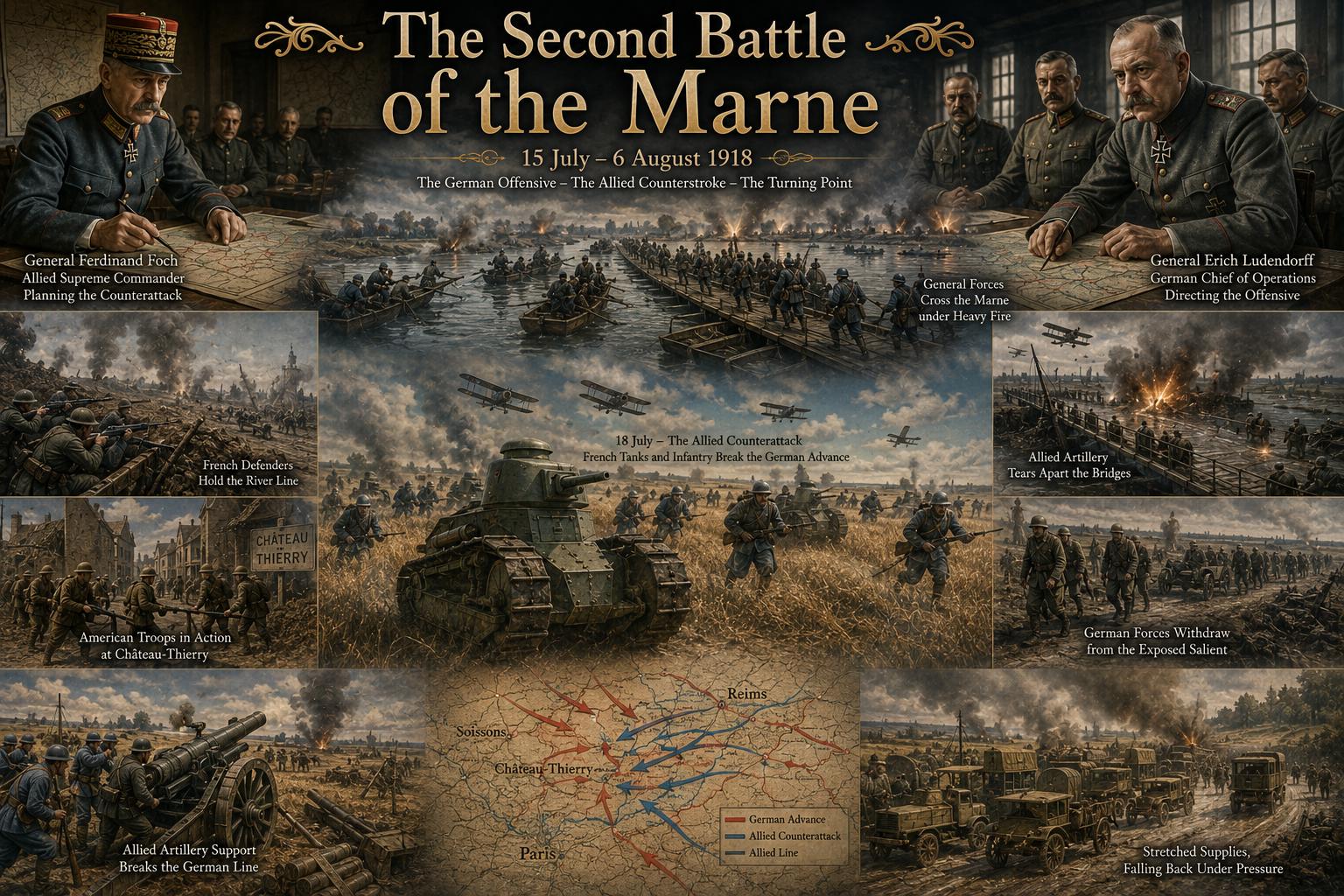
The final major phase began on 15 July 1918, when German forces launched what became known as the Second Battle of the Marne.
Ludendorff intended to draw Allied reserves away from Flanders, where he still hoped eventually to launch another decisive attack. German armies attacked east and west of Reims and attempted to cross the Marne River.
This time, however, the Allies were prepared.
Intelligence had provided warning of the offensive, and French defenses were organized differently from those encountered during earlier German attacks. Forward positions were deliberately held more lightly, while the main defensive zone was positioned farther behind the front.
German artillery struck many positions that had already been partially evacuated.
The offensive quickly lost momentum.
Then, on 18 July, the Allies launched a major counterattack led by French forces and supported by American divisions and hundreds of tanks.
The German salient around the Marne became increasingly dangerous. Ludendorff was forced to order a withdrawal.
The strategic initiative had passed permanently from Germany to the Allies.
The human cost of the Spring Offensive was enormous. From March through July, Germany suffered hundreds of thousands of casualties, with estimates commonly exceeding 600,000 when the various offensives are considered together.
The Allies also suffered extremely heavy losses. British and French armies were badly shaken during the opening attacks, and large numbers of soldiers were killed, wounded, or captured.
But the two sides could not replace losses equally.
Britain and France possessed access to their empires and global resources, while American troops were arriving in enormous numbers. Germany had no comparable source of fresh manpower.
By the summer of 1918, approximately one million American soldiers were in France, with more arriving continuously.
German morale also deteriorated.
The Spring Offensive had been presented as the operation that would finally produce victory. Soldiers initially saw spectacular advances after years of static trench warfare, creating genuine optimism.
When the offensive failed, the psychological consequences were severe.
German troops were exhausted, replacements were increasingly young or inadequately trained, food remained scarce, and Allied artillery and aircraft appeared in growing numbers.
The German Army had captured territory, but it had actually worsened its strategic position. The new salients created longer defensive lines that required additional troops to hold. Much of the captured ground had been devastated by earlier battles and offered little economic or defensive value.
Meanwhile, Allied military coordination had improved under Foch.
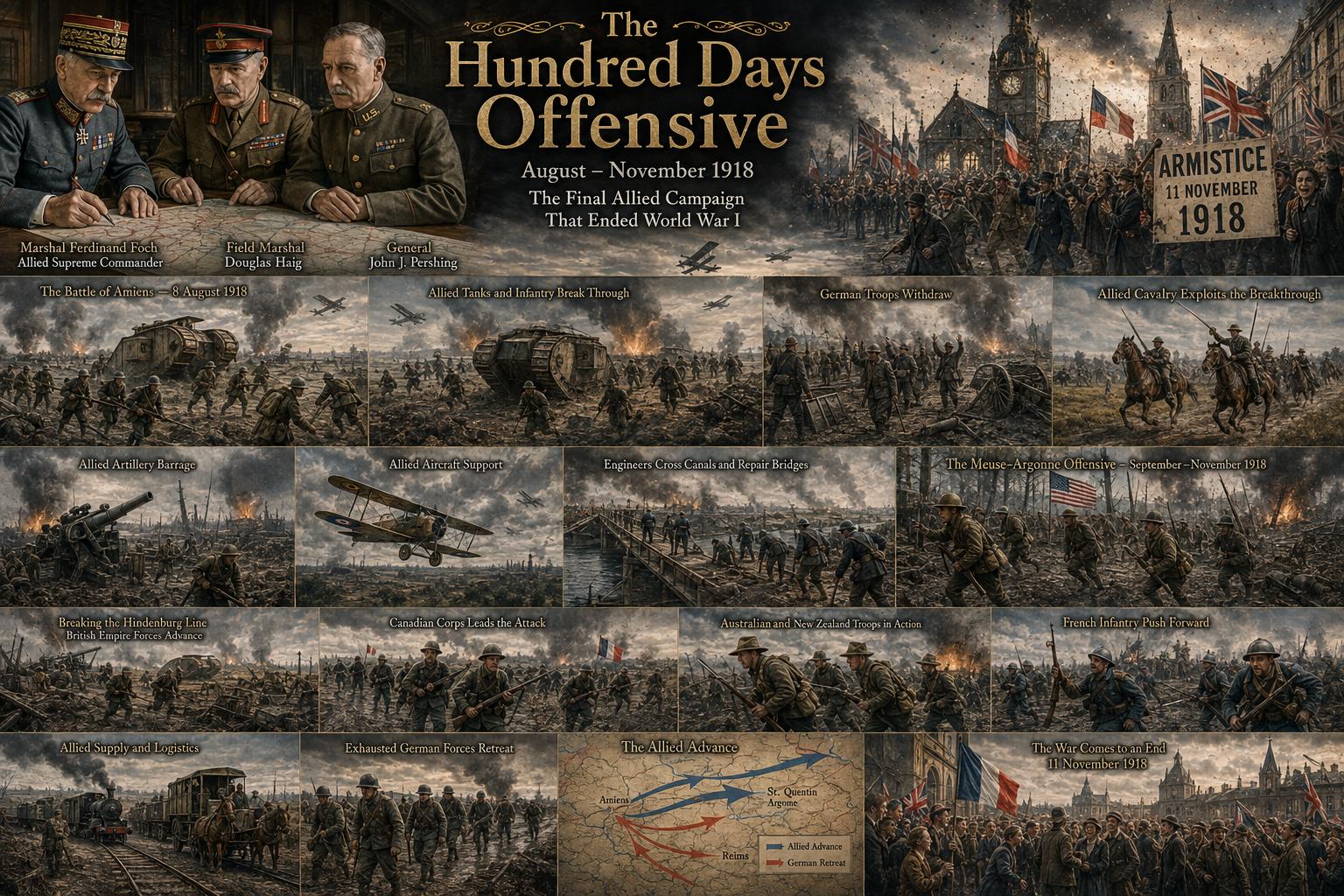
On 8 August 1918, British, Australian, Canadian, French, and other Allied forces launched the Battle of Amiens. Tanks, aircraft, artillery, and infantry achieved a major breakthrough with relatively little preliminary warning.
Ludendorff later described 8 August as the "black day of the German Army" because of the scale of defeat and the number of German soldiers surrendering.
Amiens marked the beginning of the Hundred Days Offensive, during which Allied armies repeatedly attacked German positions from August until November.
The Germans were steadily pushed back toward the Hindenburg Line and eventually beyond it.
Germany's allies were simultaneously collapsing. Bulgaria surrendered in September 1918, the Ottoman Empire followed in October, and Austria-Hungary disintegrated amid military defeat and nationalist revolutions.
Inside Germany, civilians faced hunger and political unrest. Sailors mutinied, workers demonstrated, and confidence in the imperial government collapsed.
On 11 November 1918, Germany accepted the Armistice.
The Spring Offensive therefore occupies a paradoxical place in military history. Tactically, it demonstrated some of the most sophisticated offensive methods developed during World War I. German artillery preparation, infiltration tactics, decentralized leadership, and stormtrooper operations successfully broke trench systems that had resisted years of conventional attacks.
Yet tactical brilliance could not compensate for strategic weakness.
Germany lacked the transport, reserves, fuel, food, horses, vehicles, and fresh manpower necessary to exploit breakthroughs indefinitely. Ludendorff also failed to identify and maintain a single strategic objective capable of transforming battlefield success into victory.
The campaign demonstrated another fundamental principle: capturing territory is not necessarily the same as achieving strategic success. German armies advanced farther than they had since 1914, but they failed to destroy the Allied armies, capture the Channel ports, seize Amiens, separate Britain from France, or force either country to negotiate.
Instead, the attacks consumed Germany's most valuable remaining military resources.
The role of American intervention was equally important. The United States had not yet become the dominant battlefield force when Operation Michael began, but its rapidly expanding presence created a deadline Germany could not escape. Every month that the Allies survived made Germany's strategic position worse.
This explains why Ludendorff accepted such extraordinary risks in 1918. Germany was not attacking because its long-term position was strong. It was attacking because its leaders understood that time was running out.
Ultimately, the Spring Offensive of 1918 was Germany's final and greatest gamble for victory in World War I. It shattered Allied lines, captured enormous territory, threatened Amiens and Paris, and demonstrated the devastating potential of modern infiltration tactics. Yet it failed to achieve a decisive strategic objective and inflicted losses Germany could no longer replace. When the attacks finally stalled, the German Army had exhausted the temporary advantage created by Russia's withdrawal from the war. The Allies, strengthened by unified command and rapidly growing American manpower, seized the initiative and never surrendered it. What began in March 1918 as Germany's most promising opportunity for victory ended only months later as the opening stage of its final defeat.




 The Hundred Days Offensive: How the Allies Defeated Germany in World War I
 The Russian Revolution and World War I: How War Brought Down the Tsar
 The Zimmermann Telegram Explained: Germany's Secret Offer to Mexico in World War I
 Why the United States Entered World War I: From Neutrality to War in 1917