Long before the Aztecs established Tenochtitlan, an enormous metropolis flourished in the highlands of central Mexico. Its broad ceremonial avenue passed monumental pyramids and carefully arranged architectural complexes, while extensive residential districts spread outward across a meticulously organized landscape. At its height, Teotihuacan was one of the largest cities anywhere in the ancient world, yet the identity of the people who founded it and the precise political system through which they governed remain subjects of archaeological debate.
The name Teotihuacan itself comes from the much later Aztecs, who encountered its monumental ruins centuries after the city's political decline. Its original inhabitants almost certainly called the city something else, but that name has not survived with certainty. The absence of deciphered historical texts from Teotihuacan makes its architecture especially important. The city itself is one of the principal documents through which its civilization can be reconstructed.
Teotihuacan developed in the Valley of Mexico, roughly 40 kilometers northeast of modern Mexico City. Settlement expanded dramatically during the final centuries BC and early centuries AD. By approximately AD 200, the city had already become a major political, religious, manufacturing, and commercial center. Its greatest period of influence occurred roughly between the third and sixth centuries AD.
Population estimates remain debated, but Teotihuacan probably contained tens of thousands of inhabitants and perhaps more than 100,000 at its height. Whatever the precise figure, its urban footprint was extraordinary for pre-Columbian America.
What distinguishes Teotihuacan is not merely the scale of its pyramids. Monumental structures existed elsewhere in Mesoamerica. The deeper engineering achievement was the creation of a large, deliberately ordered urban environment, in which avenues, monuments, plazas, residential compounds, drainage systems, workshops, and sacred landscapes were integrated according to recurring spatial principles.
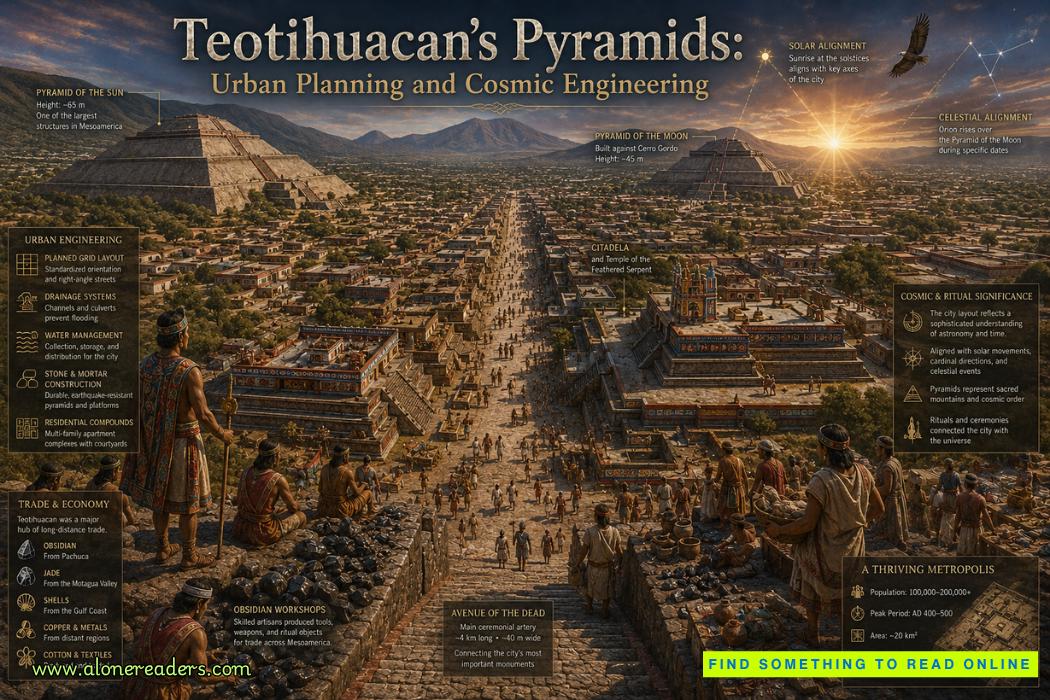
The city's dominant organizing feature is the structure now called the Avenue of the Dead. Running for several kilometers, this monumental axis connected many of Teotihuacan's most important architectural complexes. Its modern name was given by the Aztecs, who apparently interpreted structures lining the avenue as tombs. Archaeology has demonstrated that many were actually ceremonial platforms and architectural compounds.
The avenue does not align precisely with geographical north. Instead, Teotihuacan's principal urban grid is rotated approximately 15.5 degrees east of north. This orientation was applied with remarkable consistency across large portions of the city.
Why the builders selected this particular alignment remains debated. Researchers have proposed connections with astronomical observations, calendrical cycles, sacred mountains, landscape features, and combinations of these factors. The important point is that the orientation was deliberate and systematic. It shaped not only major temples but also residential compounds and streets.
This required substantial surveying expertise. Without modern optical instruments, Teotihuacan's planners established long straight axes and reproduced common orientations across a sprawling urban area. Builders would have needed dependable methods of measuring direction, right angles, distances, and elevations.
Dominating the city is the Pyramid of the Sun, one of the largest monumental structures constructed in the ancient Americas. Its base measures roughly 225 meters on each side, and the surviving structure rises approximately 65 meters. The pyramid visible today has been altered by erosion and reconstruction, but its immense mass still communicates the organizational power required to build it.
Unlike the Egyptian pyramids, Teotihuacan's monuments were not composed primarily of enormous precisely cut stone blocks. Builders created huge structural masses using combinations of stone, rubble, earth, mortar, and carefully constructed retaining surfaces. Exterior architectural elements were finished with plaster and originally painted.
This is critical when imagining ancient Teotihuacan. The city was not originally the landscape of exposed gray stone seen by modern visitors. Monumental buildings were plastered and painted, often using intense reds and elaborate murals. Temples and residential compounds would have produced a much more colorful urban environment.
The Pyramid of the Sun was constructed in major phases, probably beginning around the first or second century AD. Its placement may have been connected with an earlier sacred landscape. Beneath the pyramid lies a tunnel leading toward a chamber system, although interpretations of its original formation and ritual significance remain debated.
At the northern end of the Avenue of the Dead stands the Pyramid of the Moon. Although smaller than the Pyramid of the Sun, its location creates one of Teotihuacan's most carefully composed architectural scenes.
Behind it rises Cerro Gordo, a prominent mountain. Viewed along the city's principal axis, the relationship between pyramid and mountain creates a powerful visual connection between constructed architecture and natural landscape. The monument underwent multiple building phases, expanding over generations as Teotihuacan grew.
This integration of mountains, architecture, and urban orientation demonstrates what might reasonably be described as cosmic engineering—not mysterious technology, but the deliberate organization of built space according to religious conceptions of landscape and the cosmos.
In Mesoamerican thought, mountains could be associated with water, fertility, caves, origins, and sacred power. Pyramids could transform these ideas into monumental architecture. Teotihuacan's planners were therefore engineering not merely buildings but experiences in which political authority, ritual activity, natural geography, and cosmological concepts reinforced one another.
Farther south lies another crucial complex, the Ciudadela, a vast enclosed plaza capable of accommodating large gatherings. Within it stands the structure commonly called the Temple of the Feathered Serpent, also known as the Temple of Quetzalcoatl.
Its surviving sculptural program includes striking representations traditionally identified with feathered serpents and other supernatural beings. Archaeological excavations have also uncovered evidence of large-scale human sacrifice associated with the monument's construction and dedication. Burials containing individuals accompanied by weapons and valuable objects reveal the close relationship between monumental architecture, ritual violence, military organization, and political authority.
Building such structures required an enormous labor system. Stone and other construction materials had to be quarried, transported, prepared, and assembled. Lime plaster demanded substantial quantities of limestone and fuel for processing. Timber, water, pigments, food, tools, and labor all had to be coordinated.
Teotihuacan's monuments were therefore logistical achievements as much as architectural ones.
The city's residential organization is equally important. Earlier interpretations of ancient cities often focused almost exclusively on temples and palaces, but archaeological work at Teotihuacan has revealed an extensive landscape of apartment compounds.
Many inhabitants lived in large, multiroom masonry complexes organized around internal courtyards. These compounds could house extended families or other socially connected groups. Walls were often plastered, and some interiors contained elaborate murals depicting deities, animals, processions, water, plants, and symbolic imagery.
The prevalence of such compounds suggests that Teotihuacan underwent a major episode of urban restructuring. Instead of uncontrolled expansion around monumental centers, substantial portions of the population were accommodated within relatively standardized architectural units aligned to the city's broader grid.
This represents a sophisticated form of urban planning. The same geometric logic governing monumental architecture extended deep into everyday residential space.
Different neighborhoods also appear to have possessed distinct social and occupational identities. Archaeologists have identified evidence for communities associated with migrants from other regions of Mesoamerica, suggesting that Teotihuacan was a multiethnic metropolis.
People connected with regions such as Oaxaca and the Gulf Coast apparently lived within the city. Their presence demonstrates that Teotihuacan's influence depended not only upon military or political power but also upon long-distance networks of migration, exchange, diplomacy, religion, and commerce.
Among the city's most important industries was the production of obsidian tools and objects. Central Mexico possessed access to major sources of volcanic glass, particularly the distinctive green obsidian associated with Pachuca. Obsidian could be fractured to produce extremely sharp edges and was essential for blades, tools, weapons, and ritual objects.
Teotihuacan became deeply involved in obsidian production and distribution. Workshops transformed raw material into standardized products, while trade networks carried goods across considerable distances. Economic infrastructure therefore supported the monumental city just as surely as pyramids expressed its religious and political power.
Water management presented another significant engineering challenge. The Valley of Mexico experienced seasonal rainfall, and a city of Teotihuacan's scale needed systems capable of handling runoff, supplying communities, and protecting densely built areas.
Archaeological evidence reveals drains, canals, channels, and water-management features integrated into the urban landscape. The San Juan River was modified as the city developed, with portions of its course adjusted in relation to the urban grid.
Such intervention is particularly revealing. Rather than simply arranging streets around existing hydrology, Teotihuacan's planners modified parts of the landscape to fit the city's larger organizational scheme. Waterways, architecture, and streets became components of the same engineered environment.
Drainage was essential because plastered plazas and densely constructed compounds altered how rainwater moved across the ground. Without adequate drainage, heavy seasonal rains could flood courtyards, undermine foundations, erode surfaces, and damage buildings.
Teotihuacan engineers therefore had to think beyond individual structures. Successful urban engineering required managing the behavior of an entire inhabited landscape.
The city's enormous plazas provide another example. Large open spaces could accommodate ceremonies, markets, processions, political gatherings, or combinations of activities. Their placement controlled how people moved through monumental districts and how architecture was perceived.
Walking along the Avenue of the Dead was therefore not equivalent to moving down a modern street. Platforms interrupted sightlines, plazas changed elevation, stairways controlled access, and enormous pyramids dominated particular viewpoints. Architecture choreographed movement.
This spatial manipulation was closely connected with Teotihuacan's religious worldview. Astronomical observations clearly mattered throughout Mesoamerica, but claims about exact astronomical alignments at Teotihuacan must be treated carefully. Scholars continue debating the significance of particular orientations.
The approximately 15.5-degree grid deviation has generated numerous interpretations. Some researchers connect it with solar observations on particular dates; others emphasize calendrical relationships or nearby landscape features. There is strong evidence for deliberate orientation, but there is no scholarly consensus that a single astronomical formula explains the entire city.
That distinction is important because Teotihuacan is sometimes surrounded by sensational claims involving lost technologies or unexplained cosmic knowledge. Nothing supernatural is required to explain its achievements. The genuine accomplishments are more impressive: generations of planners developed reliable surveying practices, organized enormous labor forces, manipulated terrain and waterways, standardized urban orientations, and coordinated construction across a metropolitan landscape.
Their engineering also evolved over centuries. Teotihuacan was not built according to one immutable master plan in a single campaign. Structures were enlarged, neighborhoods reorganized, monuments rebuilt, and political priorities changed.
The Pyramid of the Moon, for example, expanded through successive construction phases. Building a new structure over an older one was common in Mesoamerica. Each enlargement could preserve sacred continuity while increasing monumentality.
This practice means that the pyramids function almost like architectural records of political history, with successive layers documenting changing ambitions.
By the sixth century, however, Teotihuacan entered a period of severe disruption. Evidence of burning and deliberate destruction appears in important elite and ceremonial areas. Exactly what happened remains disputed. Internal political conflict, social upheaval, environmental pressures, economic disruption, drought, and changes in regional power networks have all been considered.
The city's political system eventually collapsed, although occupation continued at reduced levels. By the time the Aztecs encountered the monumental ruins centuries later, the identity of Teotihuacan's original rulers had faded into legend.
Yet the city never disappeared from Mesoamerican cultural memory. The Aztecs regarded the site with profound reverence and associated it with cosmic creation. Even its later name reflects this sacred reputation.
Modern archaeology has revealed that Teotihuacan's true achievement extends far beyond its famous pyramids. The city represents a sophisticated experiment in metropolitan planning on a monumental scale. Its builders coordinated standardized orientations, residential compounds, ceremonial avenues, water systems, workshops, plazas, temples, and natural landmarks within a coherent spatial framework.
The Pyramid of the Sun and Pyramid of the Moon remain its most spectacular landmarks, but they make sense only within this larger engineered environment. They were components of a city in which architecture organized movement, reinforced political authority, materialized religious concepts, and connected human settlement with mountains, water, celestial observation, and sacred geography.
Teotihuacan's greatest engineering accomplishment was therefore not simply building enormous pyramids. It was transforming an entire landscape into an ordered urban system. Without iron tools, draft animals, or modern surveying technology, its planners created one of the ancient world's great metropolitan centers—a city whose geometry, infrastructure, monumental scale, and cosmic symbolism remain visible nearly two thousand years later.

 The Second Battle of the Marne: The Turning Point of World War I in 1918
 The Spring Offensive of 1918: Germany's Final Gamble to Win World War I
 The Treaty of Brest-Litovsk: How Russia Left World War I
 The Russian Revolution and World War I: How War Brought Down the Tsar
 The Zimmermann Telegram Explained: Germany's Secret Offer to Mexico in World War I
 Why the United States Entered World War I: From Neutrality to War in 1917