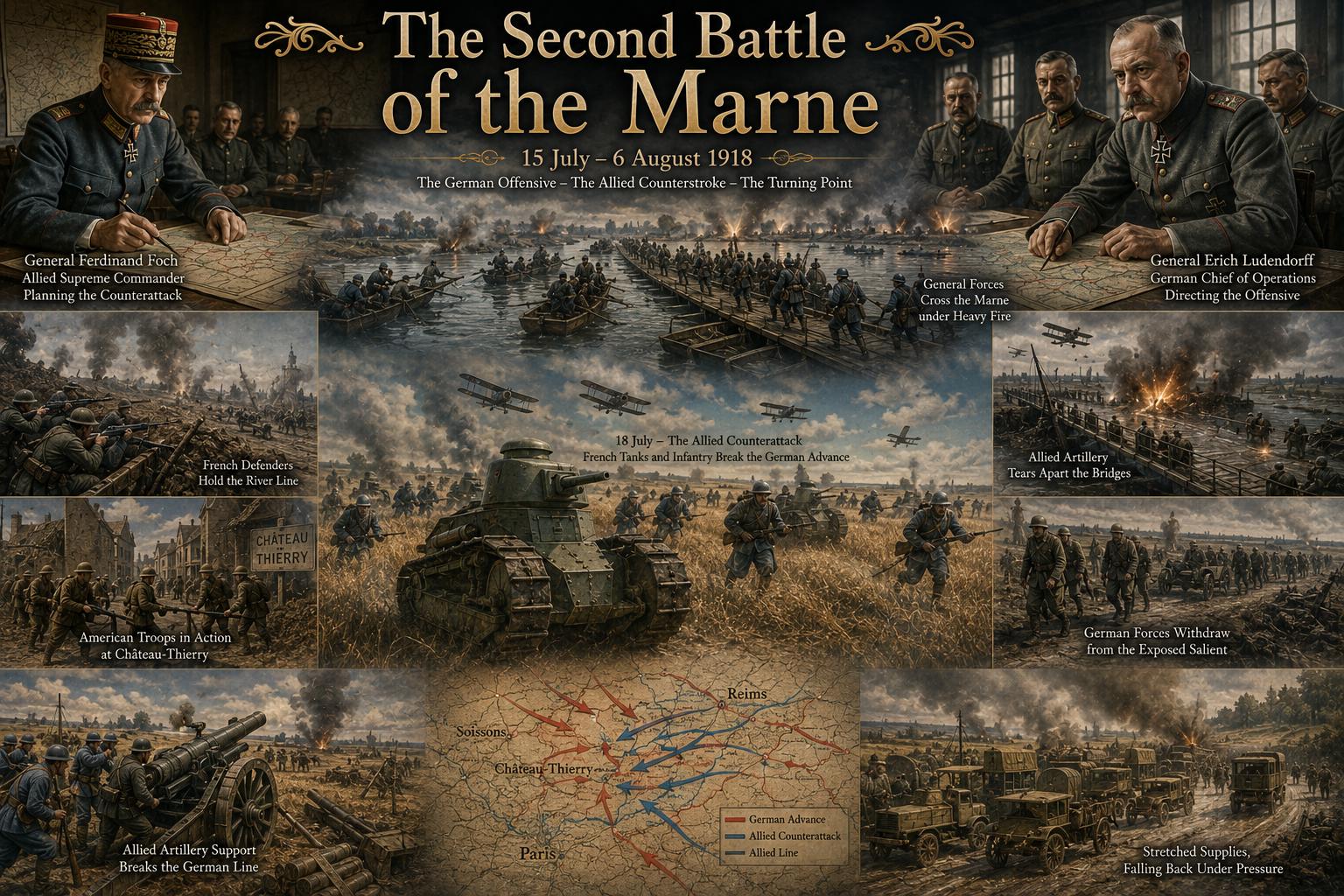
The Second Battle of the Marne, fought from 15 July to 6 August 1918, marked one of the decisive turning points of World War I. It began as Germany's final major offensive on the Western Front and ended with German armies retreating under sustained Allied pressure. Only four months earlier, Germany had launched the enormous Spring Offensive in an attempt to win the war before American military power became overwhelming. German forces had achieved remarkable territorial gains and once again approached the Marne River, threatening Paris and creating serious concern among Allied commanders. Yet at the Second Battle of the Marne, German momentum finally broke. The Allied counterattack beginning on 18 July permanently transferred the strategic initiative from Germany to the Allies and opened the road toward the Hundred Days Offensive and Germany's eventual defeat.
The strategic situation in July 1918 was the product of Germany's desperate attempt to exploit the temporary military advantage created by Russia's withdrawal from the war. The Treaty of Brest-Litovsk had formally ended fighting between Germany and Bolshevik Russia in March 1918, allowing German divisions to move from the Eastern Front to France.
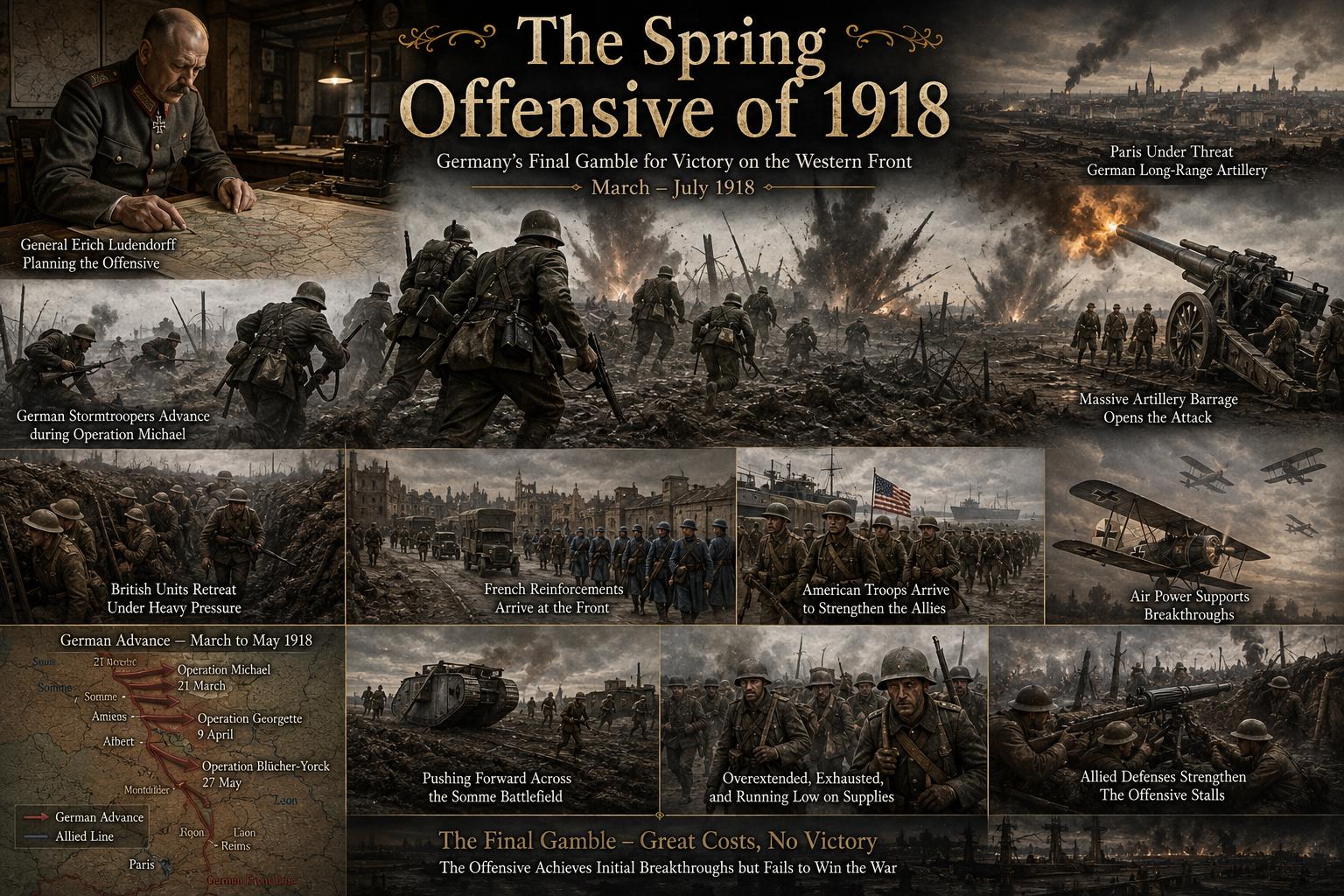
General Erich Ludendorff, who exercised enormous influence over German military strategy, understood that this advantage would not last. The United States had entered the war in April 1917, and American troops were arriving in Europe in rapidly increasing numbers. Germany therefore needed to defeat Britain and France before the American Expeditionary Forces became fully operational.
The German Spring Offensive began with Operation Michael on 21 March 1918. Subsequent offensives in Flanders and along the Aisne produced spectacular breakthroughs. During Operation Blücher–Yorck in late May, German forces shattered French defenses along the Chemin des Dames and advanced approximately 50 kilometers in only a few days.
German troops reached the Marne River, placing them roughly 90 kilometers from Paris.
The advance created what became known as the Marne salient, a large German-held bulge extending southward into Allied territory. Although its creation appeared threatening, the salient also created vulnerabilities. German forces occupying it depended upon increasingly strained roads and railway connections, while its western and eastern flanks were exposed to Allied attack.
Nevertheless, Ludendorff continued seeking a decisive opportunity.
His next operation was designed partly to draw French reserves away from Flanders, where he still hoped eventually to launch another offensive against the British. The attack around Reims and the Marne was therefore intended to weaken Allied forces and improve Germany's strategic position before another major operation farther north.
The German plan divided the offensive into two principal attacks.
East of Reims, German armies would attack French positions in Champagne. West of Reims, German forces would cross the Marne River and advance southward and eastward. If successful, these movements could threaten Reims from both sides and potentially force French forces to abandon the area.
The Germans named the offensive Friedensturm, or "Peace Offensive," reflecting hopes that another major victory might finally force the Allies to negotiate.
Yet the conditions that had produced German success earlier in 1918 were disappearing.
The Allies had learned from previous defeats. French commanders increasingly adopted defense in depth, placing fewer troops in exposed forward positions while concentrating stronger forces farther behind the front. Instead of attempting to hold every meter of the first trench line, defenders could absorb the initial German assault and then counterattack against troops separated from their artillery support.
More importantly, Allied intelligence had obtained detailed information about German preparations.
French reconnaissance, captured prisoners, aerial observation, and other intelligence sources revealed the approximate timing and location of the attack. The Allies therefore knew that a major offensive was approaching.
Shortly before midnight on 14 July, French artillery opened fire against German assembly areas and artillery positions. The Germans began their own bombardment soon afterward, but much of the element of surprise had already disappeared.
At approximately 4:35 a.m. on 15 July, German infantry began advancing.
East of Reims, the attack encountered carefully prepared French defenses. General Henri Gouraud, commanding the French Fourth Army, had deliberately withdrawn much of his infantry from the most exposed forward zone.
German artillery devastated positions that were comparatively lightly occupied. When German infantry advanced beyond the initial defensive area, they encountered stronger French positions supported by concentrated artillery.
The German attack in this sector made only limited progress.
West of Reims, however, the situation was more dangerous.
German forces crossed the Marne River using pontoon bridges, boats, and temporary crossings. They established bridgeheads south of the river despite fierce resistance.
American units participated significantly in the defense. Elements of the U.S. 3rd Division held positions along the Marne near Château-Thierry. German troops crossed the river in strength, but American soldiers resisted stubbornly.
The division's defense later contributed to its famous nickname, the "Rock of the Marne."
French, American, British, and Italian forces were all involved in different sectors of the wider battle. The presence of troops from several Allied nations reflected the increasingly integrated nature of coalition warfare by 1918.
The Germans succeeded in advancing several kilometers south of the Marne, but they failed to achieve the decisive breakthrough Ludendorff required.
The Allied defense was stronger than expected, German casualties mounted, and logistical problems complicated attempts to move supplies across the river.
Then the strategic situation changed dramatically.
Allied commander General Ferdinand Foch had been preparing a major counterattack against the western flank of the German salient. Rather than merely responding defensively to Ludendorff's offensive, Foch intended to exploit the vulnerable German position.
The counterattack began on the morning of 18 July 1918.
French armies under Generals Charles Mangin and Jean Degoutte attacked the western side of the salient between the Aisne and Marne. They were supported by American divisions and large numbers of tanks.
The attack achieved considerable surprise.
Unlike the enormous preliminary bombardments associated with earlier World War I offensives, the Allies relied heavily upon tanks and carefully coordinated artillery to preserve surprise. Hundreds of French tanks, including the highly effective Renault FT, supported advancing infantry.
The Renault FT represented an important development in armored warfare. Unlike earlier heavy tanks, it was relatively small, mobile, and equipped with a fully rotating turret. These characteristics made it well suited for infantry support.
American troops played a major role in the counterattack. The U.S. 1st and 2nd Divisions fought alongside French forces, attacking German positions around areas including Soissons and the western approaches to the salient.
The fighting was extremely intense.
German defenders possessed machine guns, artillery, and well-established positions in many locations. Allied tanks suffered losses from artillery fire and mechanical breakdowns, while infantry units sustained substantial casualties.
Nevertheless, the counterattack placed the entire German salient in danger.
The city of Soissons and its surrounding transportation network were especially important. German forces inside the salient depended heavily upon railway and road connections passing through this region. If Allied troops severed these routes, large numbers of German soldiers could become trapped.
Ludendorff quickly recognized the danger.
German reserves were redirected to contain the Allied attack, effectively destroying any remaining possibility of continuing the offensive south of the Marne.
By 20 July, German forces began withdrawing from their bridgeheads south of the river.
Germany's final major offensive on the Western Front was over.
The battle now transformed into an Allied effort to reduce the Marne salient.
German troops conducted an organized fighting withdrawal while attempting to preserve equipment and prevent Allied forces from turning the retreat into a rout. Machine-gun positions, artillery, and rear-guard units delayed advancing French and American troops.
The withdrawal was difficult because the terrain and transportation network had already suffered from months of warfare. German forces had to move artillery, ammunition, wounded soldiers, horses, vehicles, and supplies while under pressure from Allied artillery and aircraft.
Allied aviation played an increasingly important role.
Aircraft conducted reconnaissance, directed artillery fire, attacked troop concentrations, and attempted to disrupt supply movements. The Second Battle of the Marne demonstrated how thoroughly air power had become integrated into modern land warfare by 1918.
The Germans gradually abandoned territory captured during their earlier offensives.
By early August, Allied troops had advanced toward the Vesle River, while German forces withdrew to more defensible positions.
On 6 August 1918, the Second Battle of the Marne effectively ended.
The territorial changes were important, but the battle's deeper significance was psychological and strategic.
For months, German armies had appeared capable of breaking Allied defenses almost at will. Operation Michael and the subsequent offensives had captured vast areas and generated fears that the war might still end in German victory.
The Second Battle of the Marne demonstrated that this period had ended.
German offensive power had reached its limit, while Allied strength was increasing.
One major reason was manpower.
Germany had suffered enormous casualties during the Spring Offensive. Many of those lost were experienced stormtroopers, junior officers, and highly trained infantrymen who could not easily be replaced.
German divisions increasingly received younger, older, or less thoroughly trained replacements.
The Allies also suffered enormous losses, but their manpower situation was fundamentally different because of the United States.
By the summer of 1918, American soldiers were arriving in France in huge numbers. The American Expeditionary Forces under General John J. Pershing were developing into an independent army capable of major operations.
American participation at the Marne demonstrated that Germany's strategic deadline had expired. The United States was no longer merely a future threat—it was becoming an active battlefield force.
Material resources increasingly favored the Allies as well.
Britain, France, and the United States possessed greater access to food, fuel, vehicles, aircraft, artillery ammunition, tanks, horses, and global maritime trade. Germany remained weakened by the British naval blockade and years of economic exhaustion.
The Second Battle of the Marne also demonstrated the growing effectiveness of combined-arms warfare.
Infantry no longer operated alone. Successful operations increasingly required coordination among artillery, tanks, aircraft, engineers, machine guns, communications units, and logistical services.
The Allied counterattack of 18 July was particularly significant because it used surprise, armor, artillery, and multinational infantry forces to exploit a vulnerable enemy flank rather than repeatedly attacking the strongest defensive positions.
Casualties were substantial on both sides. Estimates vary, but German forces suffered well over 100,000 casualties during the wider battle, while French, American, British, and Italian forces also sustained tens of thousands of killed, wounded, and missing.
The Americans alone suffered significant losses, reflecting their increasing participation in front-line operations.
Yet Germany could afford these casualties less easily than the Allies.
The battle also strengthened Ferdinand Foch's authority. Earlier in 1918, the German breakthroughs had exposed weaknesses caused by divided Allied command. Foch had been given increasing responsibility for coordinating Allied armies.
At the Marne, this coordination produced visible results. French, British, American, and Italian troops contributed to a common strategic operation rather than fighting entirely separate national campaigns.
The victory gave Foch confidence to maintain offensive pressure.
Only two days after the Second Battle of the Marne formally ended, the Allies launched another major attack.
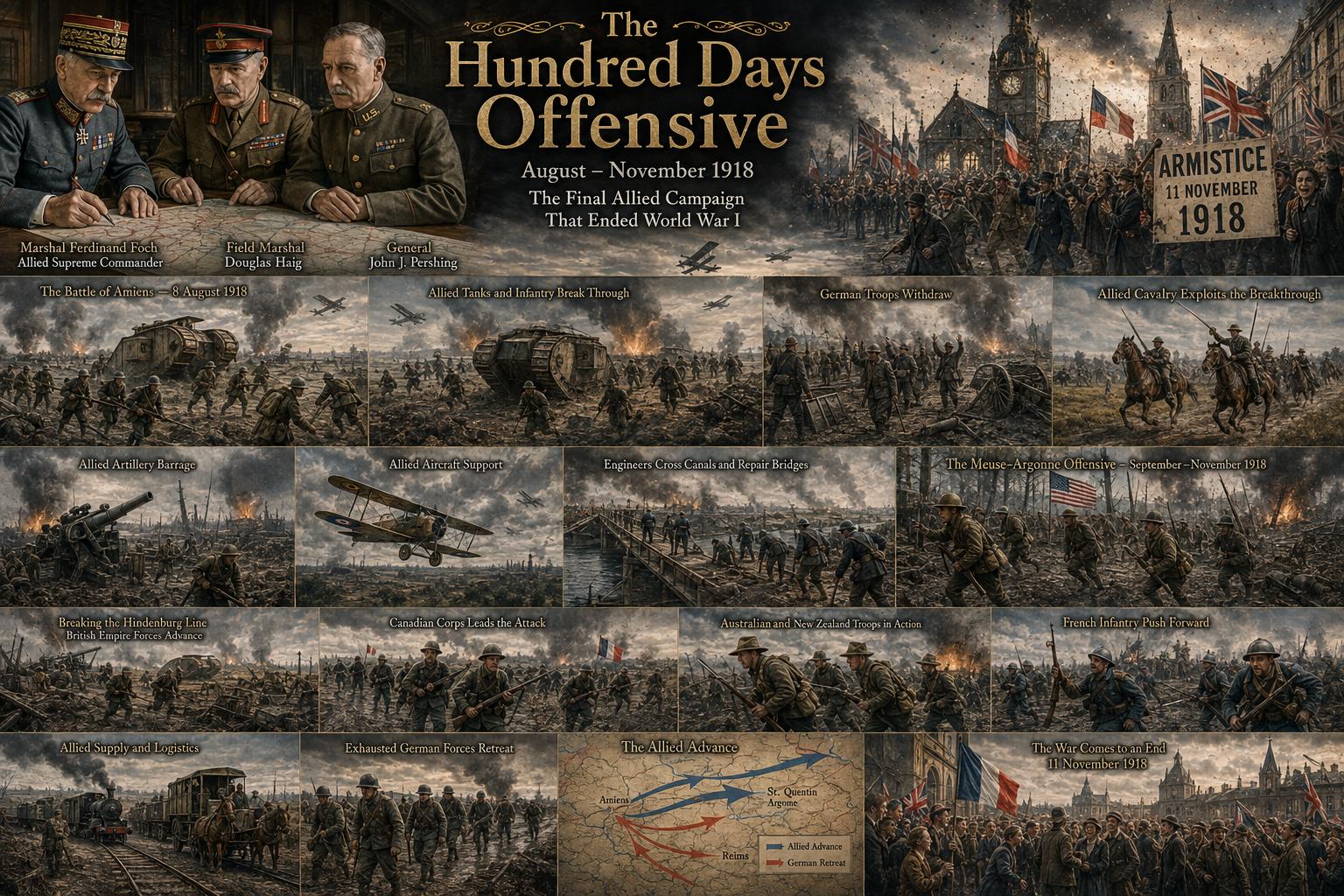
On 8 August 1918, British, Australian, Canadian, French, and other forces attacked near Amiens.
The operation achieved devastating surprise and shattered German positions. Ludendorff famously described 8 August as "the black day of the German Army", partly because large numbers of German soldiers surrendered.
The Battle of Amiens began the broader Hundred Days Offensive.
From August until November 1918, Allied armies attacked repeatedly along different sections of the Western Front. Rather than allowing Germany time to recover, they maintained pressure, forcing German commanders constantly to move reserves from one crisis to another.
German forces were pushed back toward the Hindenburg Line, which Allied armies eventually breached.
Meanwhile, Germany's allies began collapsing. Bulgaria requested an armistice in September. The Ottoman Empire followed in October. Austria-Hungary disintegrated militarily and politically.
Inside Germany, the consequences of blockade, military losses, food shortages, political unrest, and declining morale became increasingly severe.
By November, Germany's military leadership concluded that the war could no longer be won.
The Second Battle of the Marne therefore occupies a very different place in history from the First Battle of the Marne in September 1914.
The first battle stopped Germany's initial advance toward Paris and helped create the trench warfare stalemate that dominated the Western Front for years.
The second battle performed an almost opposite function.
Instead of beginning the stalemate, the Second Battle of the Marne helped end it.
After July 1918, Germany never again launched a major strategic offensive on the Western Front. Every major shift in the front thereafter moved increasingly against German interests.
The battle also exposed the limitations of Germany's Spring Offensive strategy. Ludendorff's forces had achieved spectacular tactical breakthroughs but lacked a consistent strategic objective capable of producing decisive victory.
German armies repeatedly attacked where opportunities appeared promising, creating enormous salients that were difficult to supply and defend.
At the Marne, the Allies exploited precisely this weakness.
The German salient represented territory won through enormous sacrifice, but its exposed western flank provided Foch with an opportunity for a powerful counterstroke. Territorial gain had become a strategic liability.
The battle's importance should therefore not be measured simply by kilometers captured or casualty totals. Its greatest significance was the irreversible change in momentum.
Before July 1918, Allied leaders still feared that another German breakthrough might divide their armies or threaten Paris.
After the Second Battle of the Marne, the central strategic question changed. It was increasingly no longer whether Germany could win through offensive action, but how long the German Army could continue resisting growing Allied pressure.
For German soldiers, this change was psychologically devastating. The Spring Offensive had been presented as the opportunity to achieve victory before American strength became decisive. When those attacks failed and the Allies began advancing, confidence in ultimate victory declined sharply.
For the Allies, the effect was the reverse.
The successful defense against Germany's final offensive, followed by the counterattack, demonstrated that the coalition had survived its most dangerous period. American manpower was increasing, Allied command was more unified, and tactical methods had improved significantly.
Ultimately, the Second Battle of the Marne was the moment Germany lost the strategic initiative for the final time in World War I. Ludendorff's last major offensive failed to break Allied defenses, while Foch's counterattack forced German armies into retreat and demonstrated the growing power of coordinated French, American, British, and Italian forces. The battle did not immediately end the war, but it fundamentally changed its direction. From the Marne came Amiens, from Amiens came the Hundred Days Offensive, and from the Hundred Days came the collapse of Germany's ability to continue the conflict. The Second Battle of the Marne therefore stands as one of the clearest military turning points of 1918—the battle where Germany's final bid for victory ended and the Allied advance toward the Armistice truly began.



 The Treaty of Brest-Litovsk: How Russia Left World War I
 The Russian Revolution and World War I: How War Brought Down the Tsar
 The Zimmermann Telegram Explained: Germany's Secret Offer to Mexico in World War I
 Why the United States Entered World War I: From Neutrality to War in 1917