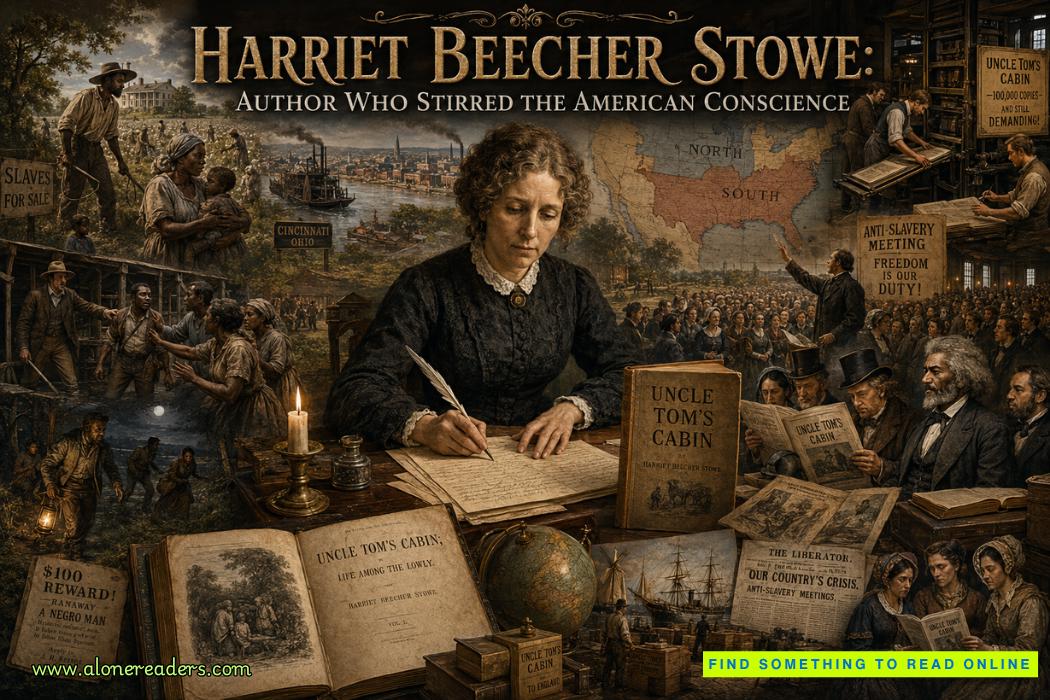
Few writers in American history have been so closely associated with a national moral crisis as Harriet Beecher Stowe. She did not command armies, hold elected office, or lead a political party. Her most powerful instrument was a novel. When Uncle Tom’s Cabin appeared in the early 1850s, Stowe transformed the distant political language of slavery into intimate stories of parents, children, husbands, wives, suffering, faith, and separation. For millions of readers, particularly those who had never personally witnessed slavery, the institution became harder to discuss as an abstraction.
Born Harriet Elisabeth Beecher on June 14, 1811, in Litchfield, Connecticut, she entered a family in which religion, education, reform, and public argument were woven into everyday life. Her father, Lyman Beecher, was one of the most prominent Protestant ministers of his generation. Several of Harriet’s siblings also became nationally important religious or reform figures. Her brother Henry Ward Beecher, for example, emerged as a famous preacher and outspoken opponent of slavery.
Her mother, Roxana Foote Beecher, died when Harriet was only five. Education subsequently became especially important in her development. She studied at the Hartford Female Seminary, an institution founded by her elder sister Catharine Beecher. At a time when advanced intellectual education for women remained restricted, Harriet received serious instruction in subjects commonly regarded as belonging to male education. This environment helped develop the intellectual confidence that would later allow her to enter some of America’s most explosive public debates.
A decisive change came in 1832, when Harriet moved with her family to Cincinnati, Ohio, after her father became president of Lane Theological Seminary. Cincinnati occupied a particularly revealing geographical position. Ohio was a free state, but Kentucky, where slavery was legal, lay directly across the Ohio River. The city therefore exposed Stowe to a society existing near the boundary between freedom and enslavement.
She encountered abolitionist arguments, heard accounts from formerly enslaved people, and became familiar with stories concerning fugitives and the slave trade. Cincinnati itself experienced fierce racial and political tensions. For Stowe, slavery was increasingly not merely a Southern institution discussed in newspapers; its consequences were visible close to the world in which she lived.
In 1836, Harriet married Calvin Ellis Stowe, a professor and clergyman. Their marriage developed into an intellectual partnership in which Harriet continued writing while managing the demanding responsibilities of a large household. The couple eventually had seven children. Her experiences as a mother would become particularly significant because Uncle Tom’s Cabin repeatedly attacks slavery through the destruction of family bonds.
The death of her young son Samuel Charles Stowe from cholera in 1849 profoundly affected her. Stowe later connected her own experience of maternal grief with her attempt to imagine the suffering of enslaved mothers whose children could be sold away from them. That connection did not make the experiences equivalent, but it contributed to the emotional framework through which she presented slavery to her readers.
The immediate political catalyst for her most famous work was the Fugitive Slave Act of 1850. Passed as part of the Compromise of 1850, the law strengthened mechanisms for capturing people accused of escaping slavery and returning them to enslavers. It also implicated citizens and officials in free states more directly in the enforcement of slavery.
For many Northerners, this changed the political geography of the issue. Slavery could no longer be treated comfortably as something confined to Southern states. The federal government was requiring the machinery of fugitive recovery to operate in free territory. Stowe responded through fiction.
Uncle Tom’s Cabin; or, Life Among the Lowly first appeared serially in the abolitionist newspaper The National Era beginning in June 1851. It was published in book form in March 1852. The response was extraordinary. The novel rapidly became a publishing phenomenon in the United States and then reached an enormous international readership through British and European editions, translations, theatrical adaptations, and related publications.
Its importance came not simply from condemning slavery, because abolitionists had already produced powerful speeches, memoirs, newspapers, pamphlets, and firsthand narratives. Stowe’s distinctive achievement was to use the structure of a popular sentimental novel to bring slavery into domestic reading culture on an unprecedented scale.
The book follows several interconnected characters, most famously Uncle Tom, an enslaved Christian man whose experiences expose different forms of brutality within the slave system. Another of its most memorable sequences concerns Eliza, who escapes with her child rather than allow him to be sold away from her. Through such episodes, Stowe concentrated attention on one of slavery’s fundamental realities: enslaved people could be bought and sold, meaning marriages could be broken and children permanently separated from parents.
Stowe deliberately made the enslaved family central to her moral argument. Her strategy was especially powerful in nineteenth-century American culture, where ideals surrounding Christian motherhood, family protection, domestic virtue, and personal morality carried enormous social weight. Readers were encouraged to imagine what it meant for a mother to know that her child could legally be sold.
Christianity was equally central to Stowe’s argument. She portrayed slavery as fundamentally incompatible with Christian morality, challenging readers who considered themselves religious while tolerating the institution. Uncle Tom’s Christian endurance became a major element of this critique. Stowe was effectively arguing that the moral authority claimed by Christian America was compromised by the continued enslavement of human beings.
The novel produced fierce controversy. Abolitionists recognized its extraordinary ability to broaden antislavery sentiment, while defenders of slavery attacked Stowe’s representation of Southern society. Proslavery writers produced so-called “Anti-Tom” novels designed to counter her narrative, often depicting plantation slavery as paternalistic and enslaved people as contented. The existence of this literary counteroffensive demonstrated how politically consequential Stowe’s book had become.
Southern critics accused her of distortion and exaggeration. Stowe responded in 1853 with A Key to Uncle Tom’s Cabin, assembling documents, legal material, newspaper reports, slave narratives, and other evidence intended to demonstrate that the conditions represented in her novel had foundations in actual American slavery.
Modern assessment of Uncle Tom’s Cabin requires greater complexity. The novel played a major role in nineteenth-century antislavery culture, yet it also contains racial stereotypes, paternalistic assumptions, and characterizations that later generations have found deeply problematic. Even the term “Uncle Tom” eventually acquired a derogatory meaning very different from the characterization Stowe intended.
This tension matters. Stowe was a white nineteenth-century reformer operating within the racial assumptions of her society, not a modern writer on race. Her antislavery commitment should therefore neither erase the limitations of her representations nor be erased by them. Understanding her historical importance requires examining both simultaneously.
It is also misleading to claim that one novel “caused” the American Civil War. The conflict emerged from decades of political struggles over slavery, territorial expansion, federal and state authority, sectional power, party collapse, secession, and the future of an economy and society built partly upon enslaved labor. Yet Uncle Tom’s Cabin undeniably became part of the cultural transformation through which slavery moved ever closer to the center of American political consciousness.
A famous story claims that when Abraham Lincoln met Stowe in 1862, he greeted her as the “little woman” who wrote the book that started the great war. The anecdote has become legendary, but historians generally treat the exact wording with skepticism because reliable contemporary documentation is lacking. Its endurance nevertheless reveals something important: later generations understood Stowe’s novel as symbolizing the immense political potential of literature.
Stowe herself did not stop writing after her great success. She produced numerous novels, essays, travel writings, religious works, and social commentary. She also addressed questions involving women’s lives and American society. Yet nothing matched the cultural force of Uncle Tom’s Cabin. That single work permanently connected her name to the struggle over slavery.
Her influence also demonstrates the complicated position of women in nineteenth-century public life. American women lacked the vote and faced significant legal and professional restrictions, yet print culture offered certain women a route into national political conversation. Stowe converted the supposedly private realms of motherhood, religion, domestic emotion, and storytelling into instruments of public persuasion.
That achievement helps explain why she belongs among history’s most influential women. Her importance does not rest on political office or formal authority. It rests on her ability to shape how enormous numbers of people emotionally understood one of the defining moral and political questions of their age.
Harriet Beecher Stowe died on July 1, 1896, in Hartford, Connecticut, at the age of eighty-five. By then slavery in the United States had been abolished for more than three decades, the Civil War had passed into national memory, and the country was struggling with the unfinished consequences of emancipation and racial inequality.
Her legacy remains contested precisely because it is substantial. Uncle Tom’s Cabin can be studied as abolitionist literature, sentimental fiction, religious argument, racial representation, mass publishing phenomenon, and political culture all at once. Its flaws reveal the limitations of nineteenth-century reform, while its extraordinary reception demonstrates how fiction can penetrate areas that speeches and legislation sometimes cannot.
Harriet Beecher Stowe’s enduring historical significance lies in her recognition that political systems are ultimately experienced by individual human beings. She presented slavery through broken families, endangered children, violence, faith, fear, escape, and loss. By doing so, she helped force readers to confront the human consequences hidden behind political terminology.
She did not abolish slavery with a book, nor did she single-handedly create the movement that destroyed it. But she accomplished something historically remarkable: she turned literature into a powerful arena of national moral confrontation. In an America moving toward its greatest internal crisis, Harriet Beecher Stowe showed that a writer armed with stories, conviction, and access to a mass readership could help disturb the conscience of a nation.




 The Hundred Days Offensive: How the Allies Defeated Germany in World War I
 The Second Battle of the Marne: The Turning Point of World War I in 1918
 The Spring Offensive of 1918: Germany's Final Gamble to Win World War I
 The Treaty of Brest-Litovsk: How Russia Left World War I
 The Russian Revolution and World War I: How War Brought Down the Tsar
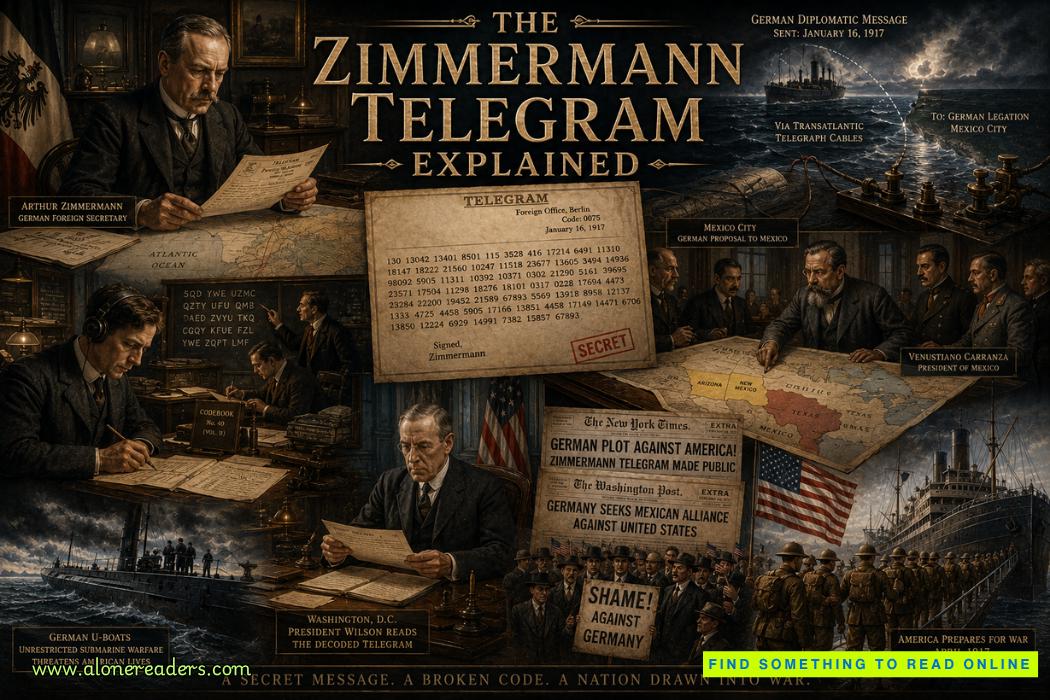 The Zimmermann Telegram Explained: Germany's Secret Offer to Mexico in World War I