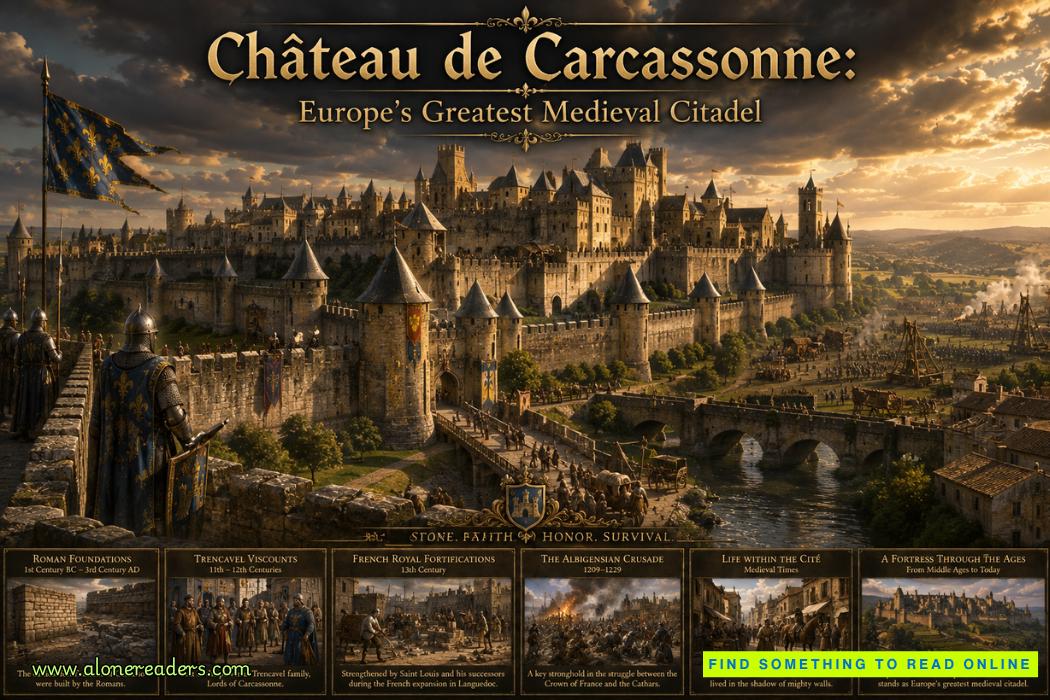
Rising dramatically above the Aude River in southern France, the fortified city of Carcassonne appears almost too perfectly medieval to be real. Its seemingly endless battlements, pointed towers, massive gates, and double rings of stone walls create one of Europe’s most recognizable fortress landscapes. Yet Carcassonne is far more than a picturesque collection of medieval architecture. Its fortifications preserve nearly two thousand years of military history, from Roman defenses to feudal warfare and the expansion of French royal authority. Few surviving European fortified cities demonstrate so clearly how defensive architecture evolved across centuries.
Carcassonne occupies an exceptionally strategic position in what is now Occitania, between the Atlantic world and the Mediterranean and close to routes connecting France with the Iberian Peninsula. Long before medieval knights appeared on its walls, people recognized the military value of the hill. Settlement existed in the area before Roman domination, but the Romans transformed Carcassonne into an important fortified center. During Late Antiquity, substantial defensive walls were constructed around the settlement. Remarkably, portions of these Gallo-Roman fortifications survive within the later medieval defenses, making the citadel an architectural record of several civilizations built literally one upon another.
After Roman authority disappeared from Gaul, Carcassonne passed through turbulent centuries involving Visigoths, Franks, Muslim forces from Iberia, and regional rulers. The Visigoths controlled the city from the fifth century and strengthened its defenses. Its location near shifting political frontiers ensured that Carcassonne remained militarily significant. Medieval chroniclers later surrounded some episodes of its history with legend, including the famous story of Lady Carcas, from whom popular tradition claims the city received its name. The tale is almost certainly legendary, but it became inseparable from Carcassonne’s cultural identity.
By the eleventh and twelfth centuries, Carcassonne had become associated with the powerful Trencavel dynasty, whose viscounts controlled important territories across Languedoc. Their residence, the Château Comtal, developed into a fortified stronghold within the already fortified city. This created a remarkable defensive arrangement: an aristocratic castle protected not merely by its own fortifications but by the walls of an entire fortified urban settlement. The surviving Château Comtal still reveals the political reality of medieval Carcassonne, where military power, aristocratic government, religion, commerce, and everyday urban life existed behind the same defenses.
The citadel became internationally important during one of medieval France’s most controversial conflicts—the Albigensian Crusade. Beginning in 1209, this campaign was directed primarily against Cathar religious influence and the southern lords accused of tolerating or protecting it. Carcassonne stood within a region where Catharism had gained considerable support. Viscount Raymond Roger Trencavel suddenly found himself confronting a crusading army arriving from northern France.
In August 1209, crusaders surrounded Carcassonne. The fortress possessed impressive defenses, but warfare depended on more than walls. The summer heat, overcrowding, shortages, and particularly access to water created enormous pressure on those trapped inside. Trencavel entered negotiations with the crusaders but was taken prisoner and subsequently died in captivity. Carcassonne fell not through a spectacular storming of its walls but through the strategic and human pressures of siege warfare. Its capture fundamentally altered the political future of the region.
Simon de Montfort emerged as a major beneficiary of the crusade and took control of Trencavel territories. Eventually, Carcassonne became incorporated into the expanding authority of the French monarchy. This transition transformed the fortress again. During the thirteenth century, French kings strengthened Carcassonne on a massive scale, particularly because the region remained politically sensitive and lay relatively close to the frontier with the Crown of Aragon.
The result was the extraordinary system visible today. Carcassonne possesses approximately three kilometres of fortified walls and more than fifty towers, arranged principally within two defensive circuits. An attacker who penetrated the outer wall still faced another powerful inner barrier. The space between the two walls, known as the lices, created a deadly controlled zone where defenders could observe and attack enemy soldiers attempting to advance toward the inner fortifications.
The towers themselves demonstrate different periods of military construction. Some preserve characteristics inherited from Roman defensive engineering, while others belong to major medieval rebuilding campaigns. Their varied shapes and construction techniques provide architectural clues to the citadel’s long development. Arrow slits enabled archers and crossbowmen to fire while remaining relatively protected, while battlements provided defensive positions along the wall tops. Gates were particularly elaborate because entrances were inevitably among the most vulnerable points of any fortress.
The Porte Narbonnaise, constructed during the royal strengthening of Carcassonne in the thirteenth century, became one of the citadel’s most formidable entrances. Twin towers dominate the approach, while defensive mechanisms could restrict and punish attackers attempting to force passage through the gateway. The Porte d’Aude on the western side offered another heavily controlled approach. Rather than relying on a single obstacle, Carcassonne used successive defensive barriers designed to slow attackers and expose them repeatedly to defenders.
Inside the walls, the Château Comtal formed another fortress in its own right. Surrounded by defensive structures and protected by a moat, it functioned as a final stronghold as well as a political residence. Its existence illustrates the concept of defense in depth exceptionally well. An invading army could theoretically breach the outer fortifications, penetrate the inner wall, and enter the city, yet still encounter an independently defensible castle.
Carcassonne was not merely a military installation. Medieval residents lived, worshipped, traded, and worked inside its walls. Among its greatest monuments is the Basilica of Saints Nazarius and Celsus, where Romanesque and Gothic architectural traditions coexist. Churches, houses, wells, streets, workshops, storage spaces, and administrative buildings made the citadel a functioning community. This distinction matters: Carcassonne represents a fortified medieval city, not simply an isolated castle occupied by soldiers and nobles.
Ironically, improvements in political geography eventually accomplished what enemy armies struggled to achieve: they made Carcassonne militarily obsolete. After the Treaty of the Pyrenees in 1659 shifted the French-Spanish frontier southward, the fortress lost much of its strategic importance. Military technology was also changing. Powerful artillery increasingly favored new forms of low, thick, geometrically designed fortification rather than towering medieval walls. Carcassonne gradually deteriorated, and by the nineteenth century parts of the complex were in serious danger.
Its survival owes much to one of the most influential—and controversial—figures in architectural conservation: Eugène Viollet-le-Duc. Beginning in the nineteenth century, an enormous restoration campaign attempted to rescue the citadel. Viollet-le-Duc reconstructed battlements, towers, roofs, and other structures according to his understanding of medieval architecture. His intervention saved Carcassonne from potentially catastrophic deterioration, but it also created lasting debate.
Critics have argued that certain restoration choices reflected an idealized interpretation of the Middle Ages rather than the precise historical appearance of every structure. The steep slate-covered conical roofs placed on many towers became especially controversial because critics considered them more characteristic of northern French architecture than traditional Mediterranean construction. Yet later scholarship has complicated some of these criticisms, and evidence suggests that pitched roofs were not necessarily as inappropriate as once claimed. Modern Carcassonne is therefore both an authentic medieval monument and a major nineteenth-century experiment in historic preservation.
Walking along the fortifications today reveals this extraordinary layering of history. Roman masonry survives beside medieval rebuilding; feudal structures stand alongside royal French defenses; Gothic architecture shares space with Romanesque elements; nineteenth-century restoration protects structures originating centuries earlier. Rather than belonging to one moment, Carcassonne is essentially a stone archive of European defensive architecture.
The Cité de Carcassonne was recognized as a UNESCO World Heritage Site in 1997, reflecting its exceptional importance as a fortified medieval ensemble and as an influential example of architectural restoration. Millions of visitors now encounter a skyline that has become almost synonymous with the popular image of the Middle Ages. Its towers have inspired illustrations, films, games, historical fiction, and countless romantic visions of medieval Europe.
Yet the real Carcassonne is more fascinating than the fantasy it often inspires. Its walls witnessed Roman frontier strategy, Visigothic rule, feudal rivalry, religious conflict, crusading warfare, royal expansion, changing borders, military obsolescence, near abandonment, and modern conservation. Every rebuilding campaign responded to a different political or military reality.
That is ultimately what makes Château de Carcassonne extraordinary. It is not simply one of Europe’s most beautiful medieval fortifications; it is one of the clearest surviving demonstrations of how fortified cities evolved, survived, lost their military purpose, and were reinvented as cultural monuments. From the Roman stones embedded in its defenses to the restored silhouettes of its medieval towers, Carcassonne compresses centuries of European history into a single spectacular hilltop citadel. Its double walls still dominate the landscape of southern France, preserving the memory of an age when stone, geography, engineering, and political power could determine the fate of entire regions.



 Château de Chambord: France’s Magnificent Renaissance Castle and Architectural Wonder
 Tehri Dam: India's Tallest Dam and the Debate Behind It
 Bhakra Nangal Dam: India's Temple of Modern Development
 Mangla Dam: Pakistan's Second Great Water Project