More About This Card
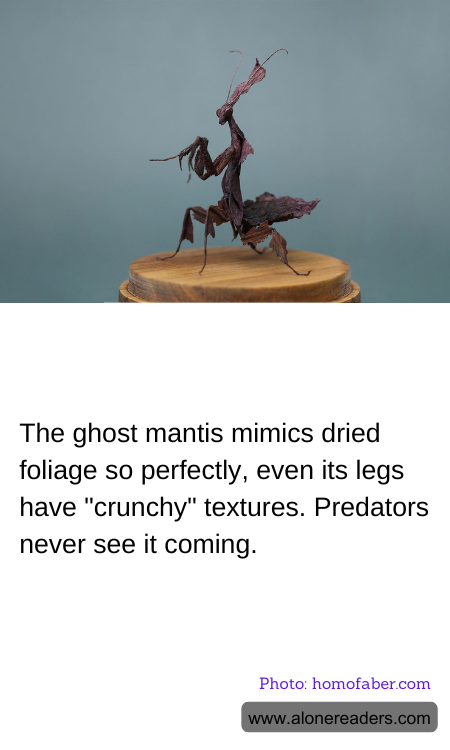
In the intricate world of nature, where survival often hinges on the ability to remain unseen, the ghost mantis stands out as a master of disguise. This remarkable insect, scientifically known as *Phyllocrania paradoxa*, has evolved to mimic dried foliage so convincingly that it can easily be mistaken for a withered leaf. Its unique appearance is not just a testament to the wonders of evolution but also a fascinating example of how creatures adapt to their environments to evade predators.
The ghost mantis is native to the arid regions of Africa and Madagascar, where its uncanny resemblance to dead leaves provides it with the perfect camouflage. Its body is adorned with leaf-like extensions, and its coloration ranges from mottled browns to greens, allowing it to blend seamlessly into its surroundings. What truly sets the ghost mantis apart, however, is the texture of its legs. These appendages are not only shaped like the stems and veins of leaves but also possess a "crunchy" texture that mimics the brittle quality of dried foliage. This attention to detail in its mimicry is what makes the ghost mantis such an elusive target for predators.
The ghost mantis's ability to remain undetected is crucial for its survival. In the wild, it faces threats from birds, reptiles, and other larger insects. By resembling a lifeless piece of vegetation, the mantis can avoid these predators, lying in wait for unsuspecting prey to wander within striking distance. Its hunting strategy is as stealthy as its appearance; the ghost mantis remains motionless, relying on its camouflage to ambush insects that come too close. This method of predation is not only efficient but also energy-conserving, as the mantis expends minimal effort while waiting for its next meal.
Beyond its practical applications, the ghost mantis's mimicry is a source of endless fascination for entomologists and nature enthusiasts alike. Its ability to deceive the eye is a reminder of the complexity and creativity inherent in the natural world. For those lucky enough to observe a ghost mantis in its natural habitat, the experience is akin to witnessing a magic trick, where the line between reality and illusion is blurred.
In a world where many species are struggling to adapt to rapidly changing environments, the ghost mantis serves as a poignant example of nature's ingenuity. Its perfect mimicry of dried foliage is not just a survival tactic but a celebration of the intricate dance between predator and prey. As we continue to explore and understand the natural world, the ghost mantis remains a symbol of the delicate balance that sustains life on our planet.