More About This Card
In the lush, vibrant rainforests of South America, an extraordinary amphibian known as the Surinam toad (Pipa pipa) exhibits one of nature's most fascinating reproductive strategies. This unique creature, often mistaken for a leaf due to its flat, camouflaged appearance, has captivated scientists and nature enthusiasts alike with its unusual method of nurturing its young.
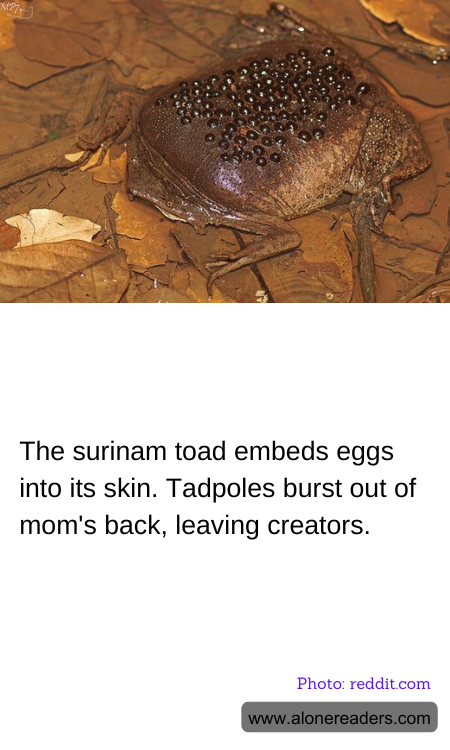
The Surinam toad's reproductive process begins with an intricate underwater dance. During mating, the male clasps onto the female's back, and as she releases her eggs, he fertilizes them. What happens next is truly remarkable: the eggs are embedded into the skin on the female's back. Over the course of several days, her skin swells and envelops each egg, forming a protective pocket. This natural incubation chamber provides a safe haven for the developing embryos, shielding them from predators and environmental hazards.
As the eggs mature, the female's back becomes a living mosaic of hexagonal chambers, each housing a developing tadpole. This unique adaptation ensures that the young are nurtured in a secure environment, receiving oxygen and nutrients directly through the mother's skin. The sight of a Surinam toad with her back covered in these tiny, pulsating pockets is both mesmerizing and slightly eerie, a testament to the wonders of evolution.
After several weeks, the moment of emergence arrives. The tadpoles, now fully developed, begin to push their way out of the mother's back. This dramatic event is akin to a miniature eruption, as the young toads burst forth from their protective chambers. The process is surprisingly quick, and within a short time, the mother's back is left with a series of crater-like impressions, a temporary reminder of her role in this extraordinary life cycle.
The Surinam toad's reproductive strategy is a striking example of nature's ingenuity. By embedding her eggs into her skin, the female provides her offspring with a level of care and protection that is rare among amphibians. This method not only increases the survival rate of the young but also highlights the diverse and often surprising ways in which life adapts to the challenges of survival.
For those fortunate enough to witness this spectacle, the Surinam toad offers a glimpse into the complex and often hidden world of amphibian reproduction. It serves as a reminder of the incredible diversity of life on our planet and the myriad ways in which species have evolved to thrive in their environments. As we continue to explore and understand the natural world, the Surinam toad stands out as a remarkable example of nature's creativity and resilience.