More About This Card
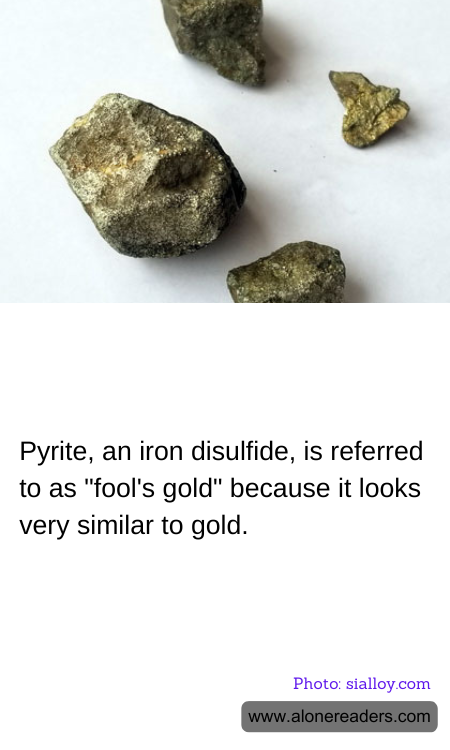
Pyrite, an intriguing mineral with the chemical formula FeS2, is often mistaken for gold due to its strikingly similar appearance. This resemblance has earned it the nickname "fool's gold," a term that has been used for centuries to describe the mineral's deceptive allure. Despite its misleading appearance, pyrite holds a unique place in both geological and cultural contexts, making it a fascinating subject for exploration.
The allure of pyrite lies in its metallic luster and pale brass-yellow hue, which can easily deceive the untrained eye. These characteristics are reminiscent of gold, leading many hopeful prospectors throughout history to mistake it for the precious metal. However, a closer examination reveals distinct differences. Pyrite is harder and more brittle than gold, and it often forms in cubic or octahedral crystals, unlike gold, which typically appears in nuggets or flakes. Additionally, pyrite leaves a greenish-black streak when rubbed against a rough surface, whereas gold leaves a yellow streak.
Beyond its visual appeal, pyrite has practical applications that extend far beyond its role as a mere impostor. It is a common mineral found in a variety of geological formations, including sedimentary rocks, metamorphic rocks, and hydrothermal veins. Pyrite is often associated with the presence of gold deposits, which can make it a valuable indicator for miners. Furthermore, pyrite is used in the production of sulfuric acid, an essential industrial chemical, and has applications in the paper and textile industries.
Culturally, pyrite has been valued by various civilizations throughout history. The ancient Greeks and Romans used it as a source of ignition for fire-starting, while Native American tribes considered it a protective stone. In modern times, pyrite is often used in jewelry and decorative items, appreciated for its aesthetic qualities and affordability compared to gold.
Despite its nickname, pyrite is far from worthless. Its unique properties and widespread occurrence make it a subject of interest for geologists, miners, and collectors alike. While it may not hold the monetary value of gold, pyrite's contribution to science and industry is undeniable. Its ability to capture the imagination and curiosity of those who encounter it ensures that pyrite will continue to be a mineral of fascination for generations to come.
In conclusion, while pyrite may be known as "fool's gold," it is anything but foolish. Its deceptive appearance has taught valuable lessons in discernment and has played a significant role in various industries. As we continue to explore the natural world, pyrite serves as a reminder that not everything that glitters is gold, but that doesn't mean it lacks worth or significance.