More About This Card
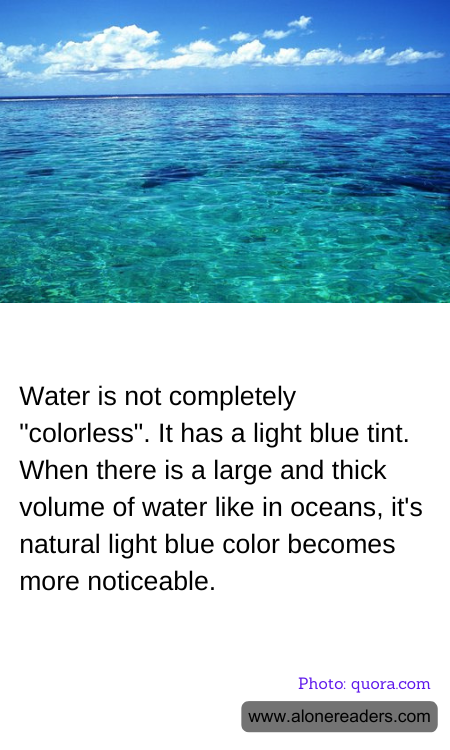
Water is often described as a colorless liquid, a notion that is widely accepted due to its transparency in small quantities. However, this description doesn't entirely capture the true nature of water. In reality, water possesses a subtle light blue tint, a characteristic that becomes more apparent when observed in large volumes, such as in oceans and deep lakes.
The blue hue of water is a result of the way it absorbs and scatters light. Water molecules absorb light from the red end of the spectrum more efficiently than from the blue end. This selective absorption means that the longer wavelengths of light, such as red, orange, and yellow, are absorbed more, leaving the shorter blue wavelengths to be scattered and reflected back to our eyes. This phenomenon is similar to why the sky appears blue, as the atmosphere scatters sunlight, allowing the blue wavelengths to dominate our vision.
In smaller quantities, such as a glass of water, this blue tint is virtually imperceptible. The thin layer of water doesn't allow for enough absorption and scattering to make the color noticeable. However, when water is present in vast quantities, like in oceans or large lakes, the cumulative effect of light absorption and scattering becomes significant, and the natural blue color of water emerges prominently. This is why oceans often appear a deep blue, especially when viewed from a distance or from above.
The intensity of the blue color can vary depending on several factors, including the presence of impurities, the angle of the sun, and the depth of the water. For instance, water that contains a high concentration of algae or other particles may appear greener due to the additional scattering of light. Similarly, shallow waters may appear lighter in color because the light doesn't have to travel as far, reducing the absorption effect.
Understanding the inherent color of water not only enriches our appreciation of natural bodies of water but also highlights the intricate interplay between light and matter. This knowledge underscores the importance of preserving our water bodies, as changes in their natural state can alter their appearance and, more importantly, their ecological balance.
In conclusion, while water is often perceived as colorless, its true nature is revealed in its light blue tint, a subtle but significant characteristic that becomes evident in large volumes. This natural phenomenon is a testament to the complex interactions between light and the natural world, reminding us of the beauty and intricacy of the environment we inhabit.