More About This Card
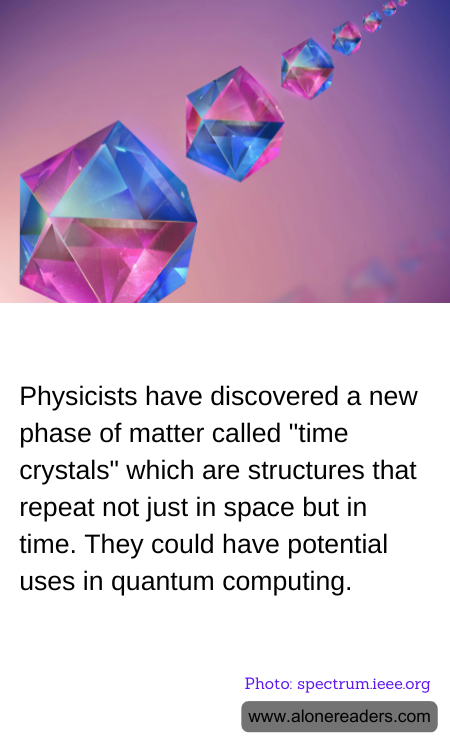
In the ever-evolving field of physics, a groundbreaking discovery has emerged that could revolutionize our understanding of matter and time. Physicists have identified a new phase of matter known as "time crystals." Unlike traditional crystals, which have structures that repeat in space, time crystals exhibit a pattern that repeats in time. This unique characteristic opens up a realm of possibilities, particularly in the realm of quantum computing.
The concept of time crystals was first proposed by Nobel laureate Frank Wilczek in 2012. He theorized that it might be possible for a system to exhibit periodic motion even in its lowest energy state, or ground state. This idea defied conventional understanding, as it suggested a form of perpetual motion within a closed system, a notion previously thought impossible due to the laws of thermodynamics. However, recent experiments have confirmed the existence of time crystals, turning theoretical speculation into tangible reality.
Time crystals are fascinating because they break time-translation symmetry, a fundamental aspect of the laws of physics that states the laws of physics are the same at any point in time. In a time crystal, the system's state changes in a regular, repeating cycle, even without external energy input. This behavior is akin to a jiggling gelatin dessert that continues to wobble indefinitely without any additional poking. The discovery of time crystals not only challenges our understanding of time and symmetry but also opens up new avenues for technological advancement.
One of the most promising applications of time crystals lies in the field of quantum computing. Quantum computers, which leverage the principles of quantum mechanics, have the potential to solve complex problems far beyond the reach of classical computers. However, they are notoriously difficult to build and maintain due to issues like decoherence, where quantum states lose their integrity over time. Time crystals could play a crucial role in stabilizing quantum systems, as their unique properties might help maintain coherence in quantum bits, or qubits, thereby enhancing the performance and reliability of quantum computers.
Beyond quantum computing, the implications of time crystals could extend to other areas of technology and science. They might offer insights into the fundamental nature of time itself, potentially leading to new theories that could reshape our understanding of the universe. As research into time crystals continues, scientists are hopeful that these enigmatic structures will unlock new possibilities, pushing the boundaries of what we know about the physical world.
In conclusion, the discovery of time crystals marks a significant milestone in physics, challenging existing paradigms and offering exciting prospects for future technological advancements. As researchers delve deeper into the mysteries of time crystals, we stand on the brink of a new era in science, where the interplay of time and matter could redefine our understanding of reality and open up unprecedented opportunities in fields like quantum computing.