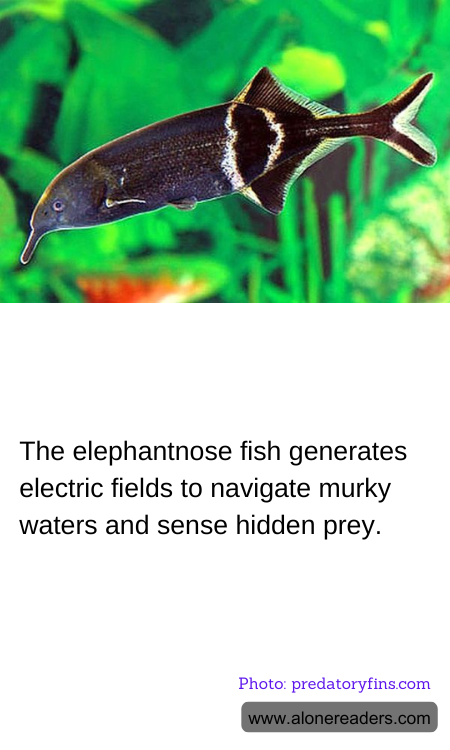
More About This Card
In the mysterious depths of Africa's freshwater rivers, a remarkable creature known as the elephantnose fish (Gnathonemus petersii) navigates its murky environment with a unique evolutionary adaptation. This small, nocturnal fish, named for its elongated, trunk-like chin appendage, possesses an extraordinary ability to generate electric fields, a skill that sets it apart in the animal kingdom. This fascinating capability allows the elephantnose fish to thrive in its challenging habitat, where visibility is often limited, and prey can be elusive.
The elephantnose fish's electric field generation is a sophisticated biological process. It possesses specialized cells called electrocytes located in an organ at the base of its tail. These cells produce weak electric fields, which the fish uses to explore its surroundings. As the electric field radiates outward, it interacts with objects and living organisms in the water. The fish's skin is lined with electroreceptors that detect changes in the electric field caused by these interactions. This sensory information is then processed by the fish's brain, enabling it to construct a detailed map of its environment.
This electric sense is particularly advantageous in the turbid waters where the elephantnose fish resides. In such conditions, traditional visual cues are often unreliable, making it difficult for predators and prey alike to navigate. However, the elephantnose fish's electric field allows it to detect obstacles, locate hiding places, and most importantly, sense the presence of prey even when it is concealed under sediment or within crevices. This ability to "see" with electricity provides the fish with a significant survival advantage, allowing it to hunt effectively and avoid potential threats.
Beyond navigation and hunting, the electric field also plays a role in communication among elephantnose fish. These fish can modulate the frequency and amplitude of their electric signals to convey information to one another, such as signaling territorial boundaries or attracting mates. This form of communication is crucial in the dense aquatic environments they inhabit, where sound and sight are often compromised.
The elephantnose fish's reliance on electric fields is a testament to the incredible diversity of adaptations found in nature. It highlights how species can evolve unique solutions to environmental challenges, ensuring their survival and success. For scientists, the study of the elephantnose fish offers valuable insights into the evolution of sensory systems and the potential applications of bioelectricity in technology and medicine.
In conclusion, the elephantnose fish is a captivating example of nature's ingenuity. Its ability to generate and interpret electric fields not only underscores the complexity of life in aquatic ecosystems but also inspires curiosity and wonder about the myriad ways organisms adapt to their environments. As we continue to explore and understand these remarkable creatures, they remind us of the endless possibilities that lie within the natural world.