More About This Card
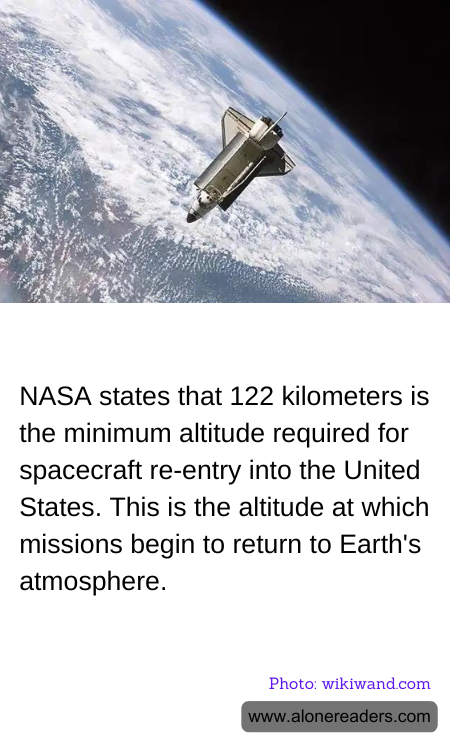
In the vast expanse of space exploration, the intricacies of spacecraft re-entry into Earth's atmosphere are both fascinating and crucial for the success of missions. NASA, the United States' leading space agency, has determined that an altitude of 122 kilometers (approximately 76 miles) is the minimum threshold required for spacecraft to begin their descent back to Earth. This specific altitude marks the point where the thin veil of Earth's atmosphere starts to exert its influence on returning spacecraft, initiating the complex process of re-entry.
At 122 kilometers above the Earth's surface, the atmosphere is still exceedingly thin, but it is dense enough to begin interacting with the spacecraft. This interaction is critical as it marks the transition from the vacuum of space to the more substantial atmospheric layers. The spacecraft, traveling at high velocities, encounters increasing air resistance, which plays a pivotal role in slowing it down. This deceleration is essential for a safe re-entry, as it helps manage the intense heat generated by friction between the spacecraft's surface and atmospheric particles.
The choice of 122 kilometers as the minimum re-entry altitude is not arbitrary. It is the result of extensive research and testing by NASA to ensure the safety and success of space missions. At this altitude, the spacecraft's heat shield, a vital component designed to withstand extreme temperatures, begins to perform its function. The heat shield protects the spacecraft and its occupants from the searing heat that can reach temperatures of up to 1,650 degrees Celsius (3,000 degrees Fahrenheit) during re-entry. This protective barrier is crucial for maintaining the structural integrity of the spacecraft and ensuring the safety of any astronauts on board.
Re-entry is one of the most challenging phases of a space mission. It requires precise calculations and engineering to ensure that the spacecraft enters the atmosphere at the correct angle and speed. A shallow angle could result in the spacecraft skipping off the atmosphere back into space, while a steep angle could lead to excessive heat and pressure, potentially causing catastrophic failure. Therefore, the 122-kilometer mark is a carefully chosen point that balances these factors, providing a safe and effective path back to Earth.
NASA's determination of this altitude is a testament to the meticulous planning and expertise involved in space exploration. It underscores the importance of understanding the delicate interplay between spacecraft and Earth's atmosphere, ensuring that missions not only reach their destinations but also return safely. As humanity continues to explore the cosmos, the knowledge and experience gained from these re-entry procedures will pave the way for future advancements in space travel, inspiring generations to reach for the stars while safely returning home.