More About This Card
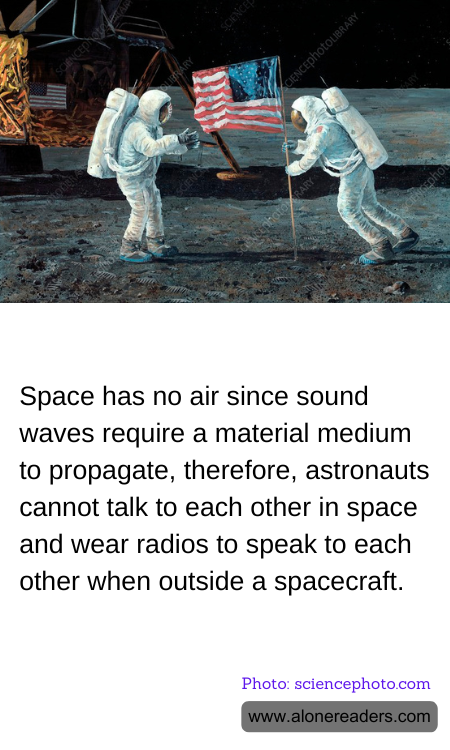
In the vast expanse of space, where the stars twinkle in a silent ballet, one might wonder why astronauts, despite being surrounded by the wonders of the universe, cannot simply speak to each other as they do on Earth. The answer lies in the fundamental nature of sound and the unique environment of space. Sound, as we experience it, is a wave that travels through a medium, such as air, water, or solid materials. On Earth, when we speak, our vocal cords create vibrations that travel through the air, allowing others to hear us. However, space is a vacuum, devoid of air and other materials that can carry sound waves. This absence of a medium means that sound cannot propagate, rendering the cosmos eerily silent.
For astronauts working outside their spacecraft, this presents a unique challenge. Without the ability to rely on sound waves to communicate, they must turn to technology to bridge the gap. Radios become an essential tool, allowing astronauts to converse with each other and with mission control. These devices convert spoken words into radio waves, which can travel through the vacuum of space. Once received, the radio waves are converted back into sound, enabling communication despite the absence of air.
The use of radios is not just a convenience but a necessity for safety and coordination during spacewalks, known as extravehicular activities (EVAs). During these missions, astronauts are often tasked with complex operations, such as repairing equipment or conducting scientific experiments. Clear and reliable communication is crucial to ensure that these tasks are completed safely and efficiently. Radios allow astronauts to receive instructions, report their status, and alert others to any potential issues, all while floating in the silent void of space.
The reliance on radios also highlights the ingenuity and adaptability of human technology. By understanding the limitations imposed by the environment of space, scientists and engineers have developed solutions that enable astronauts to overcome these challenges. This innovation is a testament to human curiosity and our desire to explore the unknown, even when faced with seemingly insurmountable obstacles.
In essence, the silence of space serves as a reminder of the unique conditions that exist beyond our planet. It underscores the importance of technology in enabling human exploration and communication in environments vastly different from our own. As we continue to venture further into the cosmos, the lessons learned from these experiences will undoubtedly pave the way for future discoveries and advancements, allowing us to explore the universe while staying connected, even in the absence of sound.