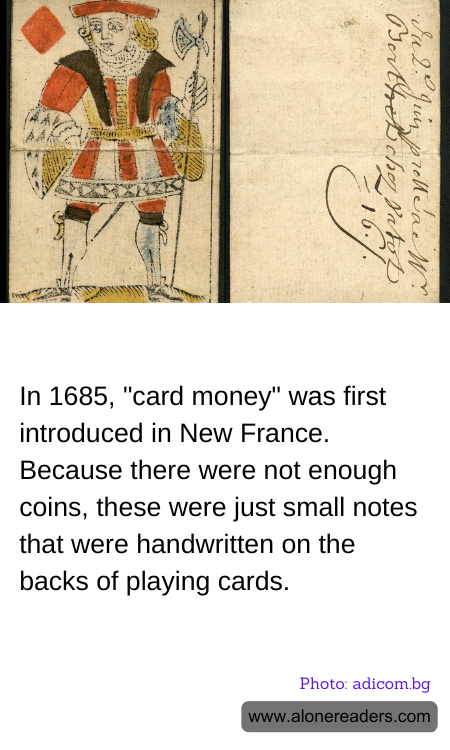
More About This Card
In the year 1685, a unique and innovative solution to a pressing economic problem was introduced in New France, a French colony in North America. Faced with a shortage of coins, the colony's administrators devised an ingenious method to facilitate trade and commerce: the creation of "card money." This early form of paper currency was not only a practical response to a financial dilemma but also a fascinating chapter in the history of money.
The scarcity of coins in New France was a significant issue. The colony's economy was growing, but the supply of metal currency was insufficient to meet the demands of trade and daily transactions. To address this, Jacques de Meulles, the Intendant of New France, proposed an unconventional solution. He suggested using playing cards as a substitute for coins. These cards were readily available and could be easily adapted to serve as a medium of exchange.
The process of creating card money was straightforward yet ingenious. Playing cards were cut into quarters, and on the back of each piece, a handwritten note was inscribed, indicating its value. These notes were then signed by the Intendant and other officials to authenticate them. The card money was issued in various denominations, allowing it to function much like modern currency. This system provided the colony with a flexible and practical means of conducting transactions without the need for metal coins.
Card money quickly gained acceptance among the colonists, who appreciated its convenience and utility. It facilitated trade and commerce, allowing the economy of New France to continue growing despite the lack of traditional currency. The success of this system demonstrated the adaptability and resourcefulness of the colony's administrators and set a precedent for the use of paper money in other parts of the world.
While card money was initially intended as a temporary solution, it remained in use for several decades. Its introduction marked a significant moment in the history of currency, highlighting the importance of innovation in overcoming economic challenges. The use of playing cards as money in New France is a testament to human ingenuity and the ability to adapt to changing circumstances.
Today, the story of card money serves as a reminder of the creative solutions that can arise from necessity. It also underscores the evolution of currency from tangible coins to the diverse forms of money we use today. As we reflect on this fascinating chapter in history, we can appreciate the enduring impact of these early financial innovations on the development of modern economic systems.