More About This Card
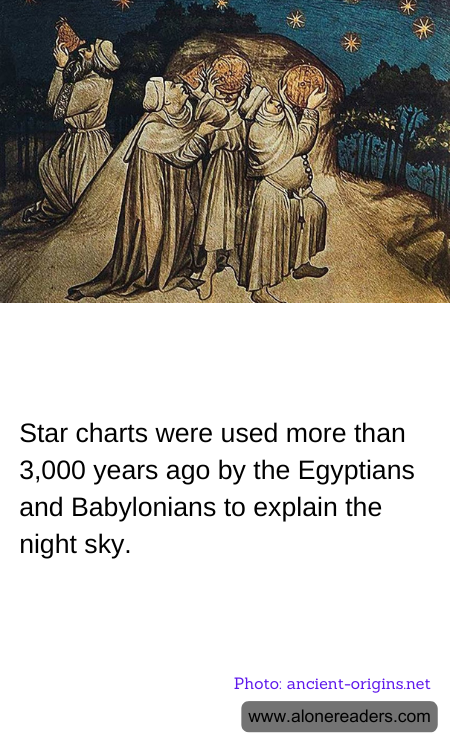
The night sky has always been a source of wonder and mystery for humanity. Long before the advent of modern technology, ancient civilizations sought to understand the celestial bodies that adorned the heavens. Among the earliest to systematically chart the stars were the Egyptians and Babylonians, who, over 3,000 years ago, developed star charts to explain the night sky.
The Egyptians, renowned for their architectural and astronomical prowess, were deeply fascinated by the stars. They believed that the heavens were a reflection of the divine order, and thus, the stars held significant religious and cultural importance. The Egyptians used star charts to align their monumental structures, such as the pyramids and temples, with specific celestial events. This alignment was not only a testament to their engineering skills but also a reflection of their belief in the stars' influence on earthly affairs. The star charts helped them track the movements of celestial bodies, which were crucial for agricultural planning and religious ceremonies.
Similarly, the Babylonians, who inhabited the region of Mesopotamia, were pioneers in the field of astronomy. They meticulously observed the night sky and recorded their findings on clay tablets. These early astronomers developed sophisticated star charts that mapped the positions of stars and planets. The Babylonians were particularly interested in the cyclical nature of celestial events, such as eclipses and planetary movements, which they believed were omens from the gods. Their star charts were not only tools for prediction but also served as a means to interpret divine messages, guiding decisions in both personal and state affairs.
The star charts of these ancient civilizations laid the groundwork for future astronomical studies. They represented an early attempt to impose order on the cosmos, transforming the night sky from a chaotic array of lights into a structured map that could be studied and understood. This endeavor required careful observation, mathematical calculations, and a deep understanding of the natural world. The legacy of these early star charts is evident in the way we continue to study and appreciate the stars today.
In modern times, we have advanced technology that allows us to explore the universe in ways the Egyptians and Babylonians could never have imagined. However, their early efforts to chart the stars remind us of the enduring human desire to understand our place in the cosmos. These ancient star charts are a testament to the ingenuity and curiosity of our ancestors, who, with limited resources, sought to unravel the mysteries of the night sky. As we gaze upon the stars today, we are connected to a long tradition of celestial exploration that began thousands of years ago with the Egyptians and Babylonians.