More About This Card
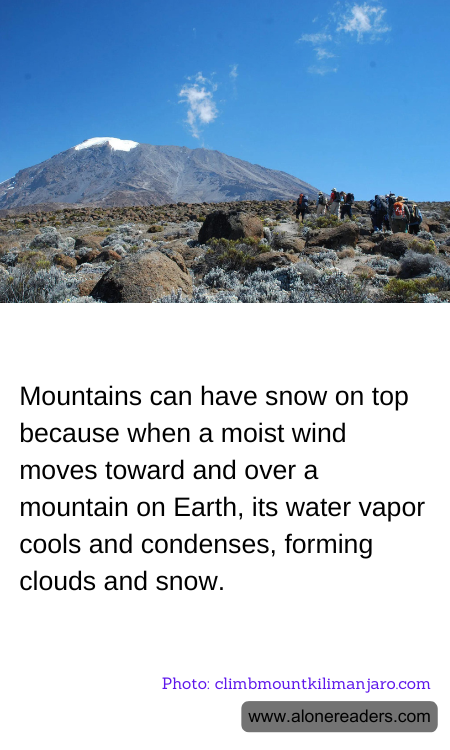
Mountains, with their majestic peaks and breathtaking vistas, are often crowned with snow, creating a picturesque scene that captivates the imagination. This natural phenomenon, where snow blankets the summits even during warmer months, is a result of intricate atmospheric processes involving moist winds, temperature changes, and the unique topography of mountains.
When moist winds approach a mountain, they are forced to ascend due to the mountain's towering presence. As the air rises, it encounters lower atmospheric pressure, causing it to expand and cool. This cooling effect is crucial because it leads to the condensation of water vapor present in the air. The process of condensation forms clouds, which are essentially collections of tiny water droplets or ice crystals suspended in the atmosphere.
As the air continues to rise and cool, the temperature may drop below the freezing point, especially at higher altitudes. This is where the transformation from clouds to snow occurs. The ice crystals within the clouds grow larger as they collide and stick together, eventually becoming heavy enough to fall as snow. This process is known as orographic precipitation, a term derived from the Greek word "oros," meaning mountain, and "graphia," meaning writing or description.
The presence of snow on mountain tops is not just a visual spectacle but also plays a vital role in the Earth's climate system. Snow-covered peaks reflect a significant amount of solar radiation back into space, helping to regulate the planet's temperature. This reflective quality, known as albedo, is crucial in maintaining the delicate balance of the Earth's climate.
Moreover, the snow that accumulates on mountains serves as a natural reservoir, storing water in the form of ice. As temperatures rise during warmer months, the snow melts, feeding rivers and streams that provide essential water resources for ecosystems and human populations downstream. This seasonal melting is a critical component of the water cycle, supporting agriculture, hydropower, and drinking water supplies.
The phenomenon of snow-capped mountains is a testament to the dynamic interactions between the Earth's atmosphere and its varied landscapes. It highlights the delicate balance of natural processes that sustain life on our planet. Understanding these processes not only enriches our appreciation of nature's beauty but also underscores the importance of preserving these vital ecosystems for future generations.
In essence, the snow on mountain tops is a result of the harmonious interplay between moist winds, cooling temperatures, and the towering presence of mountains. It is a reminder of the intricate and interconnected systems that govern our planet, offering both aesthetic beauty and essential resources that sustain life.