More About This Card
Air travel has become an integral part of modern life, offering a swift and efficient means of traversing vast distances. However, one of the challenges pilots and passengers often face is turbulence. This phenomenon is particularly common when airplanes navigate the atmospheric layers, specifically as they transition from the troposphere to the stratosphere. Understanding why turbulence occurs during this transition requires a closer look at the atmospheric conditions and the role of jet streams.
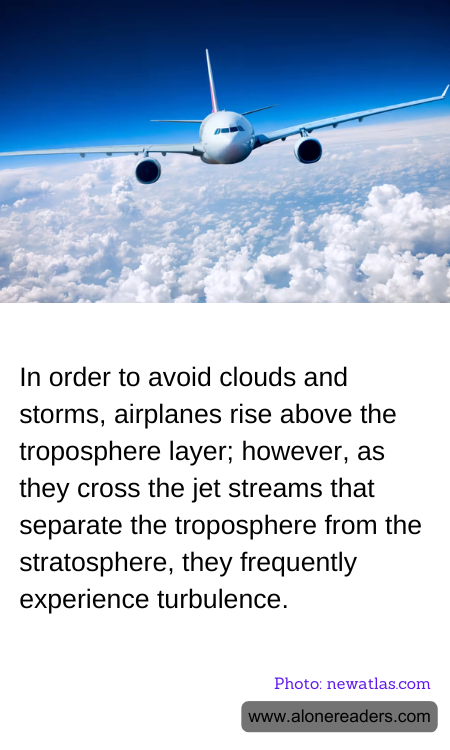
The troposphere is the lowest layer of Earth's atmosphere, extending up to about 8 to 15 kilometers above sea level. It is where most of our weather occurs, including clouds, rain, and storms. To avoid these weather-related disturbances, airplanes typically ascend to higher altitudes, often reaching the lower stratosphere. This layer, situated above the troposphere, is generally more stable and free from the weather patterns that characterize the lower atmosphere. However, the boundary between these two layers is not a simple, calm transition. It is marked by the presence of jet streams, which are fast-flowing, narrow air currents that can significantly impact flight conditions.
Jet streams are powerful winds that flow from west to east and are found near the tropopause, the boundary separating the troposphere from the stratosphere. These streams can reach speeds of over 200 miles per hour and are primarily driven by the temperature differences between the equator and the poles. As airplanes cross these jet streams, they often encounter turbulence. This is because the jet streams create a sharp contrast in wind speed and direction, leading to a phenomenon known as wind shear. Wind shear can cause sudden changes in an aircraft's altitude and speed, resulting in the bumpy ride passengers often experience.
While turbulence can be unsettling, it is generally not dangerous to the aircraft. Modern airplanes are designed to withstand significant stress, and pilots are trained to handle turbulent conditions. Moreover, advancements in meteorological technology allow pilots to anticipate and navigate around areas of severe turbulence. Despite these precautions, turbulence remains a common occurrence, especially when crossing jet streams.
For passengers, understanding the nature of turbulence can alleviate some of the anxiety associated with it. It is a natural part of flying and is often a sign that the aircraft is transitioning between different atmospheric layers. While it may cause discomfort, it is a temporary and manageable aspect of air travel.
In conclusion, the journey from the troposphere to the stratosphere is a critical phase of flight that often involves crossing jet streams. These powerful air currents are responsible for much of the turbulence experienced during flights. While turbulence can be an uncomfortable experience, it is a normal part of flying and is well within the capabilities of modern aircraft and their crews to manage safely. As air travel continues to evolve, so too will the methods for predicting and mitigating turbulence, ensuring a smoother journey for all.