More About This Card
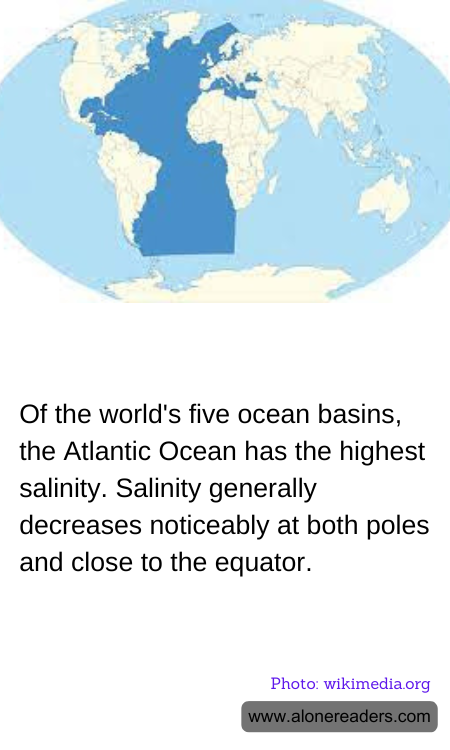
The Atlantic Ocean, one of the world's five major ocean basins, is renowned for its distinct characteristic of having the highest salinity levels among its peers. Salinity, the concentration of salt in water, is a crucial factor that influences oceanic circulation, climate, and marine life. The Atlantic Ocean's elevated salinity levels are primarily attributed to its unique geographical and climatic conditions.
The Atlantic Ocean's salinity is influenced by several factors, including evaporation, precipitation, river inflow, and ocean currents. In regions where evaporation exceeds precipitation, such as the subtropical areas, salinity tends to be higher. The Atlantic Ocean, particularly in its central and northern parts, experiences significant evaporation due to its warm temperatures and prevailing winds. This process leaves behind a higher concentration of salt, contributing to the ocean's overall salinity.
Conversely, salinity levels tend to decrease noticeably at both the poles and near the equator. In polar regions, the influx of freshwater from melting ice caps and glaciers dilutes the salt concentration, resulting in lower salinity. Additionally, the cold temperatures in these areas reduce evaporation rates, further contributing to the decreased salinity. Near the equator, the situation is somewhat similar, albeit for different reasons. The equatorial regions receive substantial rainfall, which dilutes the ocean's salt content. Moreover, the presence of large river systems, such as the Amazon and Congo, which discharge vast amounts of freshwater into the Atlantic, further reduces salinity levels in these areas.
The variations in salinity across the Atlantic Ocean have significant implications for global ocean circulation. Salinity, along with temperature, affects the density of seawater, which in turn influences ocean currents. The Atlantic Meridional Overturning Circulation (AMOC), a major component of the global ocean conveyor belt, is driven by these density differences. The high salinity in the North Atlantic contributes to the sinking of dense, salty water, which propels the AMOC and plays a critical role in regulating climate patterns across the globe.
Understanding the salinity patterns of the Atlantic Ocean is essential for comprehending the broader dynamics of Earth's climate system. As climate change continues to impact global weather patterns, monitoring changes in ocean salinity becomes increasingly important. Scientists are keenly observing these shifts, as alterations in salinity can have far-reaching effects on marine ecosystems, weather systems, and sea level rise.
In conclusion, the Atlantic Ocean's high salinity levels are a defining feature that sets it apart from other ocean basins. The interplay of evaporation, precipitation, and freshwater inflow creates a complex mosaic of salinity patterns that influence oceanic and atmospheric processes. As we continue to explore and understand the intricacies of our planet's oceans, the study of salinity remains a vital component in unraveling the mysteries of Earth's climate and environmental health.