More About This Card
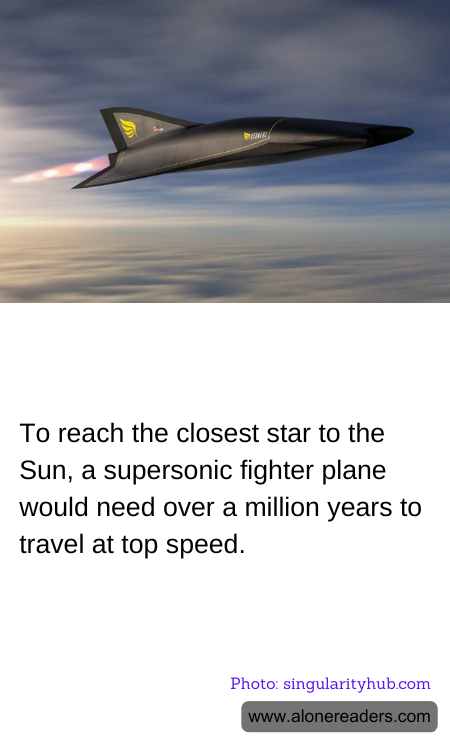
The vastness of space is a concept that often defies human comprehension. While the stars appear as tiny, twinkling dots in the night sky, they are, in reality, colossal celestial bodies separated by unimaginable distances. One of the most intriguing aspects of these distances is the time it would take to travel to the closest star to our Sun, Proxima Centauri, using conventional means. Even with the fastest technology available today, such as a supersonic fighter plane, the journey would take over a million years.
Proxima Centauri is part of the Alpha Centauri star system and is located approximately 4.24 light-years away from Earth. To put this into perspective, a light-year is the distance light travels in one year, which is about 5.88 trillion miles (9.46 trillion kilometers). This means that even the closest star is staggeringly far from us. A supersonic fighter jet, which can reach speeds of around 1,500 miles per hour (2,414 kilometers per hour), is incredibly fast by Earthly standards. However, when faced with the cosmic scale, this speed becomes almost negligible.
If we were to calculate the time it would take for such a plane to reach Proxima Centauri, the numbers become mind-boggling. Traveling at top speed without stopping, it would take over 1.5 million years to cover the distance. This is a testament to the sheer scale of the universe and highlights the limitations of our current technology when it comes to interstellar travel. The notion of a million-year journey underscores the need for advancements in propulsion technology if humanity ever hopes to explore beyond our solar system.
The concept of traveling to the stars has long been a source of fascination and inspiration in science fiction. However, the reality is that our current capabilities are limited to exploring our own solar system. Missions to Mars, for instance, are considered ambitious, yet they pale in comparison to the challenge of reaching another star. Scientists and engineers are continually working on developing new technologies, such as ion propulsion and theoretical concepts like warp drives, which could potentially make interstellar travel feasible in the future.
For now, the idea of reaching the stars remains a dream, but it is one that drives innovation and exploration. The vast distances serve as a reminder of the incredible scale of the universe and our small place within it. As we continue to explore and learn more about the cosmos, the hope is that one day, humanity will find a way to bridge these immense gaps and reach out to the stars. Until then, the journey to Proxima Centauri remains a tantalizing possibility, waiting for the day when technology catches up with our dreams.